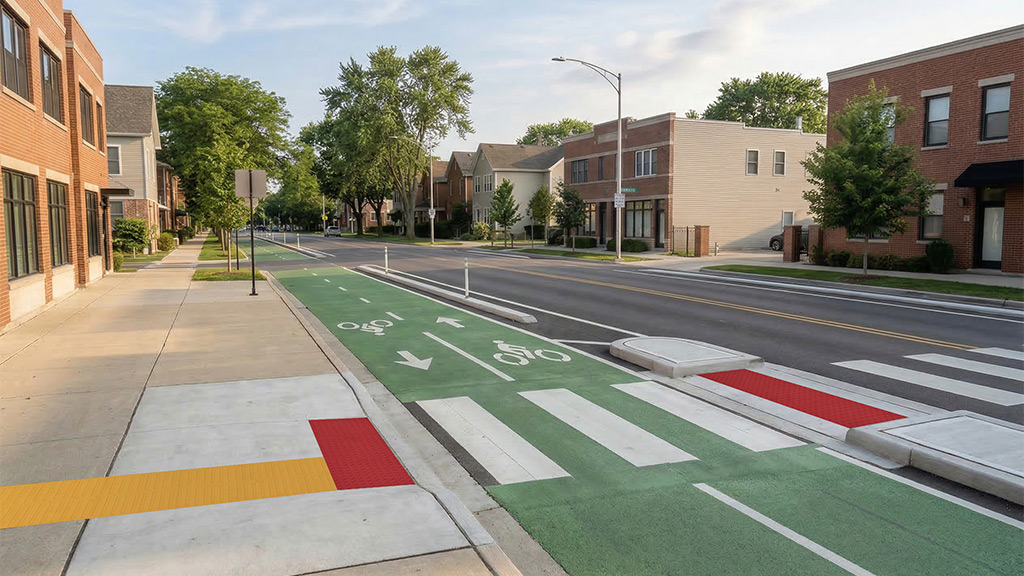
Pedestrian refuge islands can make longer or more complex street crossings easier to navigate by providing a designated space between segments of vehicular traffic. But for pedestrians who are blind or have low vision, reaching an island in the middle of a crossing can introduce an important question: Have I reached the opposite sidewalk, or is there another portion of the street still ahead?
Detectable warning surfaces help communicate that distinction. When properly incorporated into a pedestrian refuge island, truncated domes provide a recognizable tactile warning at the points where the pedestrian route transitions between the island and vehicular way.
For project teams, accessibility at pedestrian refuge islands requires more than simply adding detectable warning tiles. Island dimensions, warning placement, crossing geometry, visual contrast, alignment, and the overall pedestrian route all need to work together.
What Is a Pedestrian Refuge Island?
A pedestrian refuge island is a designated area within a street crossing where pedestrians can pause between segments of traffic. Refuge islands may be located within a median, at a roundabout, or as part of another roadway configuration that separates traffic movements.
Some islands include curb ramps, while others use a cut-through design that allows the pedestrian route to remain at street level as it passes through the island.
Not every island within a roadway functions as a pedestrian refuge. Size and configuration matter. Current federal public-right-of-way accessibility requirements address pedestrian refuge islands that are at least 6 feet long in the direction of pedestrian travel. Smaller or painted islands are not treated the same way for detectable-warning purposes.
That distinction should be established early when planning the crossing rather than assuming every median or traffic island requires the same tactile treatment.
Why Detectable Warnings Matter at Refuge Islands
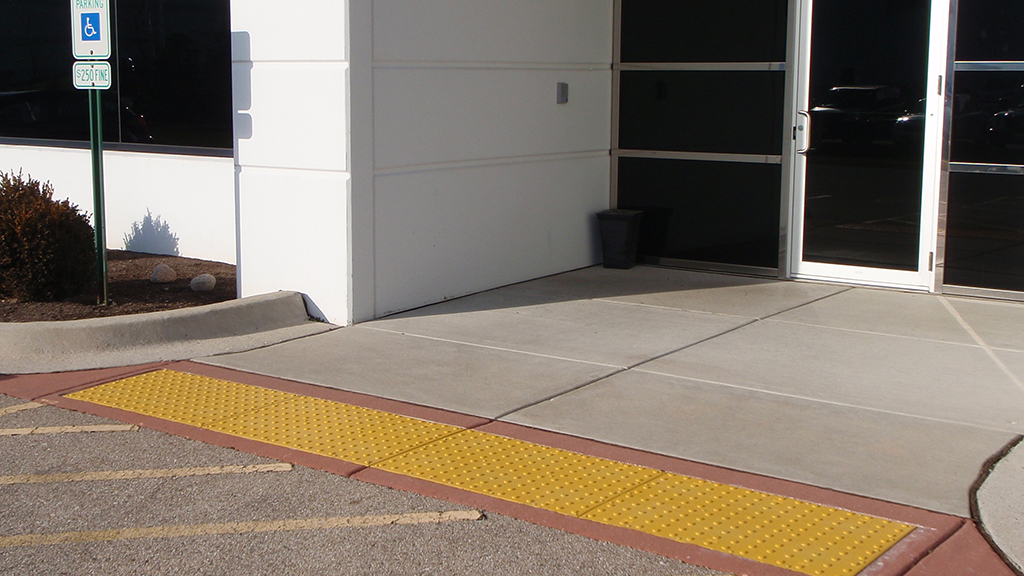
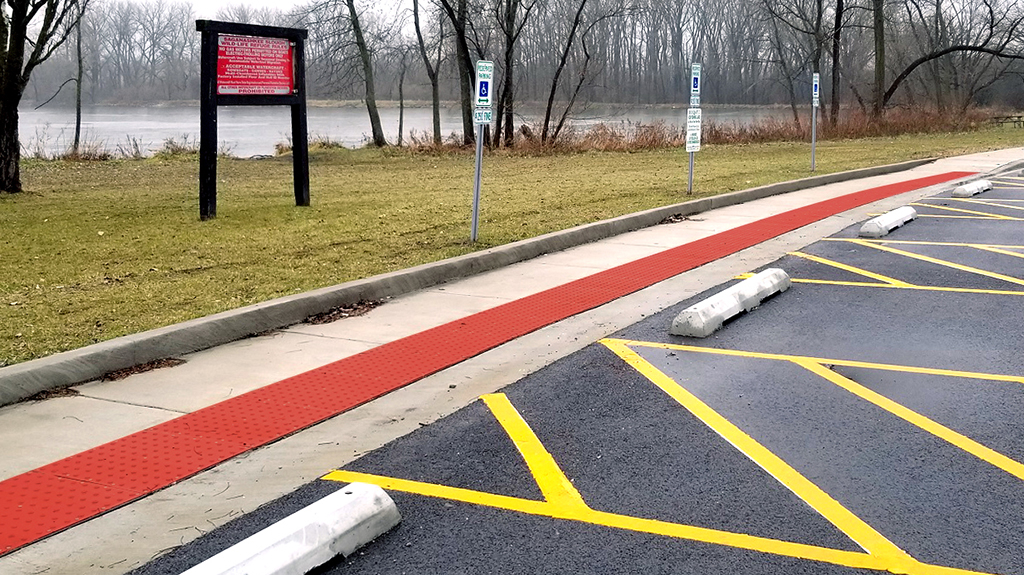
Detectable warning surfaces use a standardized pattern of truncated domes to alert pedestrians who are blind or have low vision to a transition or hazard.
At a typical street crossing, encountering the warning surface at a curb ramp or blended transition indicates the boundary between the pedestrian way and the vehicular way.
A refuge island adds another layer to that journey.
A pedestrian may encounter one detectable warning when entering the street, another when reaching the refuge island, another when leaving the island, and a final warning when reaching the opposite side of the crossing.
That sequence helps communicate that the island is part of the crossing rather than necessarily the end of it. The distinction can be particularly important at wide or complex intersections where the entire crossing may involve multiple traffic lanes, islands, bicycle facilities, or more than one signal phase. Research and guidance on tactile wayfinding specifically recognize the importance of context when pedestrians encounter multiple warning surfaces within these environments.
Detectable Warning Placement at Pedestrian Refuge Islands
For cut-through pedestrian refuge islands, current federal public-right-of-way accessibility criteria require detectable warning surfaces at the edges of the pedestrian island, with at least 2 feet of surface without detectable warnings between them.
In practical terms, the two warning fields identify separate transitions:
Entering the Refuge Island
The first detectable warning encountered after crossing a portion of the street communicates the transition out of the vehicular way and onto the pedestrian refuge.
Leaving the Refuge Island
The second warning communicates that the pedestrian is about to leave the refuge and enter another portion of the vehicular way.
The clear space between the warning fields helps make those two boundaries distinguishable rather than creating what could be perceived as one continuous field of truncated domes.
Project teams should confirm the requirements governing the specific project, since state, local, transportation-agency, or owner criteria may supplement applicable federal requirements.
Warning and Alignment Are Different Functions
Detectable warning surfaces communicate a warning, but they do not tell a pedestrian which direction to travel through a crossing.
That distinction can become especially important at refuge islands where the second segment of a crossing does not continue in a straight line.
Truncated domes should not be relied upon as an alignment tool. In more complex configurations, additional tactile information may be considered to help pedestrians establish the correct crossing direction.
Tactile Alignment Cues
Raised-bar tactile directional indicators can provide an alignment cue in certain crossing configurations where other environmental information is insufficient or confusing.
Current research-based guidance describes alignment bars placed near detectable warnings at crossings, including certain island, roundabout, and channelized-turn-lane conditions. Their orientation can provide a physical cue corresponding with the direction of the crosswalk.
These raised-bar treatments serve a different purpose from the truncated domes and should remain tactilely distinguishable from the warning surface.
Because national U.S. standards do not currently establish TDI use in the same way they establish requirements for detectable warning surfaces, project teams should distinguish between required DWS treatments and research-based or agency-specific guidance for directional and alignment cues.
Consider the Entire Crossing, Not Just the Island
A refuge island rarely exists in isolation. Its accessibility depends on how it connects with the rest of the pedestrian route.
Project teams should evaluate the crossing as a complete sequence, including:
- Curb ramps or blended transitions
- Detectable warning locations
- Island dimensions and clear space
- Crosswalk direction and alignment
- Accessible pedestrian signals or other crossing information, where applicable
- Visual contrast between detectable warnings and adjacent surfaces
- Drainage, slopes, joints, and surrounding pavement conditions
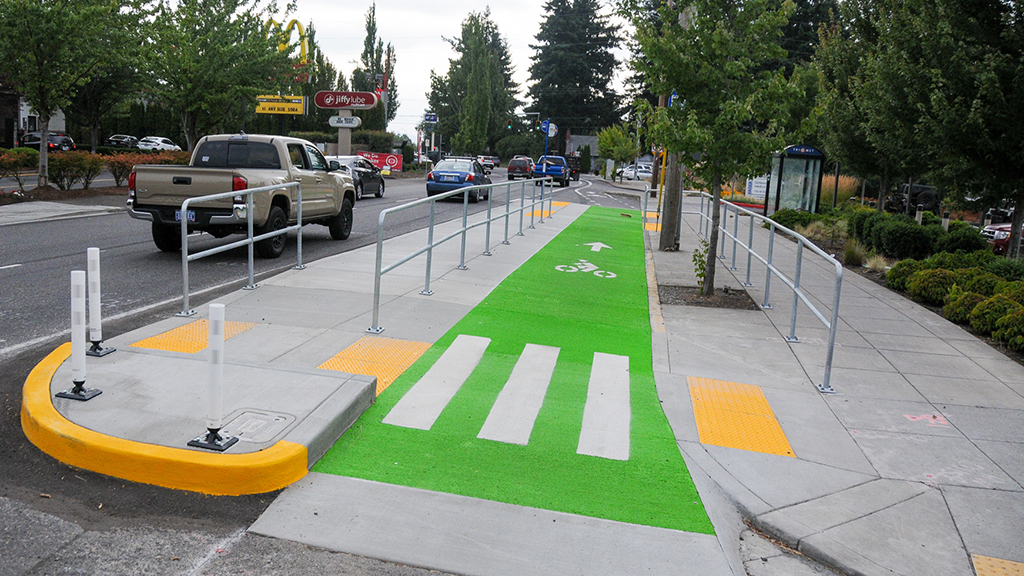
This whole-route perspective becomes particularly important at complex crossings. A pedestrian might encounter a sidewalk-level bicycle lane, vehicular lanes, a refuge island, additional traffic lanes, and another bicycle facility before reaching the destination sidewalk. The tactile information at each transition needs to remain understandable within that larger sequence.
Visual Contrast Supports Tactile Information
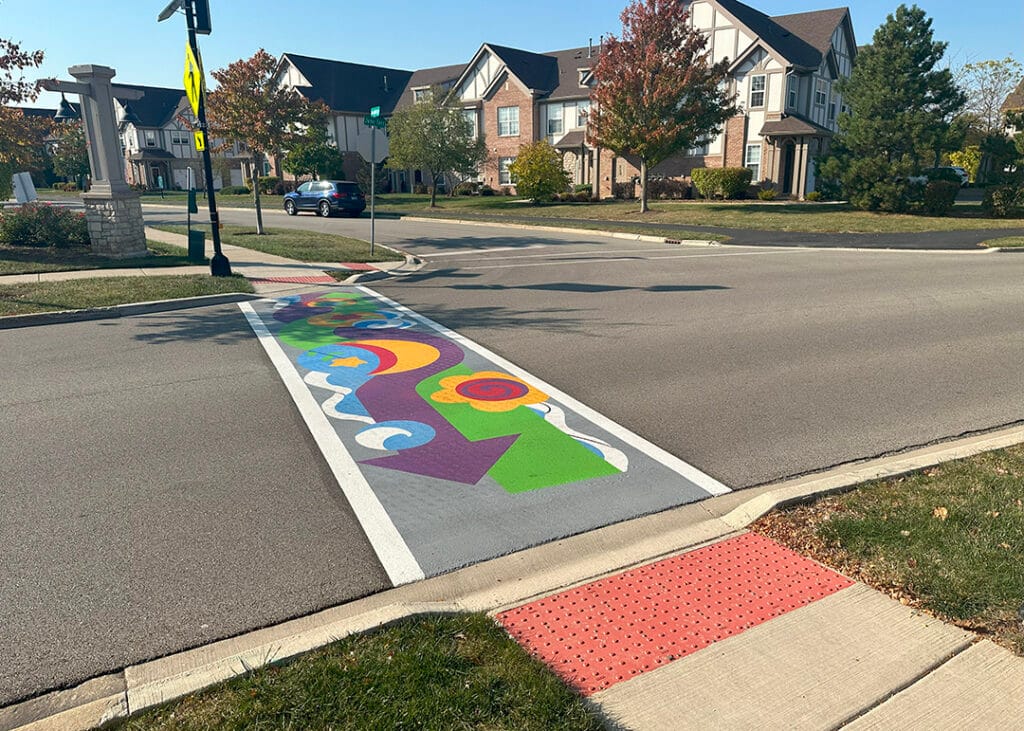
Although truncated domes provide the tactile warning, detectable warning surfaces also need to contrast visually with adjacent walking surfaces using the applicable light-on-dark or dark-on-light relationship. This can help pedestrians with low vision identify transitions within the crossing visually as well as tactually.
There is no single color that is appropriate for every refuge island. The selected warning surface should be evaluated in relation to the surrounding concrete, asphalt, pavers, or other walking surfaces, along with any color requirements established by the agency or jurisdiction.
For refuge islands containing two warning fields relatively close together, coordinating color and surrounding paving can also help the island read as a distinct pedestrian space rather than as an extension of the roadway.
Plan Refuge Island Accessibility as a System
Pedestrian refuge island accessibility is ultimately about communicating a sequence of transitions clearly.
The detectable warnings at each side tell pedestrians when they are moving between a pedestrian refuge and a vehicular way. Clear space between those warnings helps distinguish the two boundaries. Where crossing geometry makes alignment difficult, additional tactile or environmental cues may help communicate the direction of travel.
Those details are most effective when they are planned together rather than added independently late in the project.
By considering the island as part of the complete pedestrian journey—from the first curb ramp through each crossing segment to the destination sidewalk—project teams can create crossings that provide clearer, more predictable information for pedestrians with a wide range of abilities.