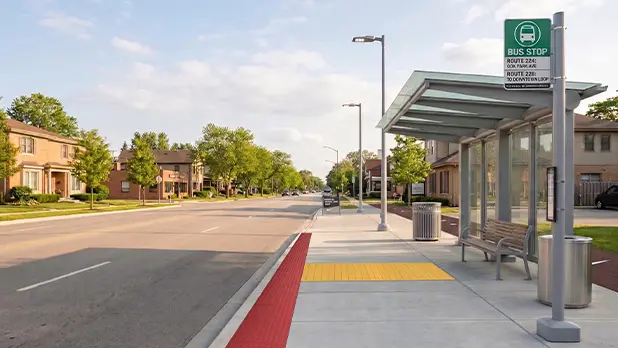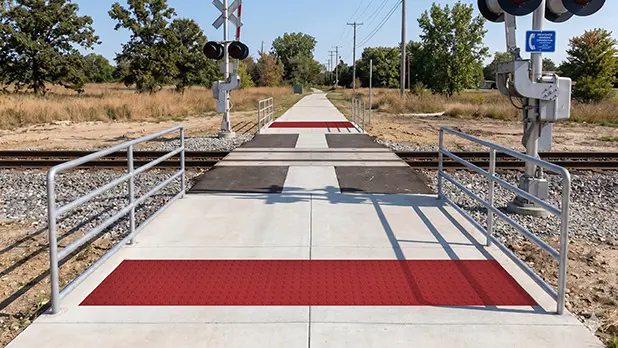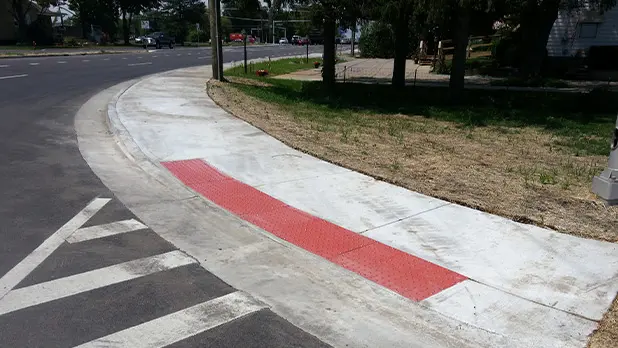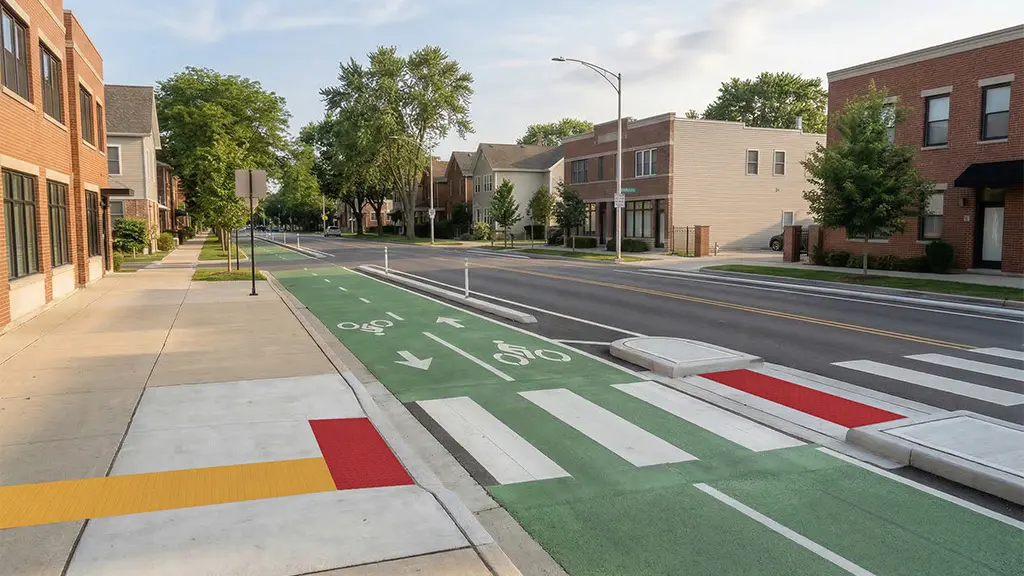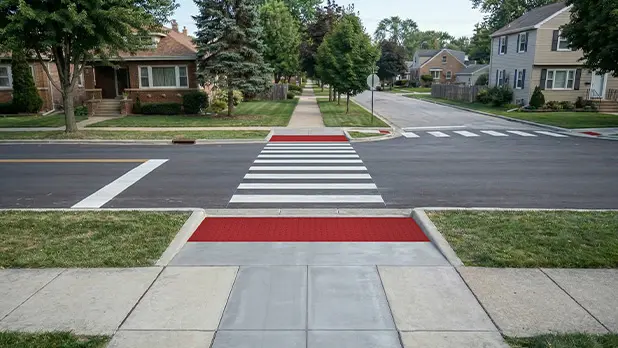
A sidewalk crosses a driveway. Vehicles cross the pedestrian route. So should there be a detectable warning at the driveway?
Not necessarily.
This is one of those accessibility questions where the site can look simple while the answer depends on an important detail: how the driveway is controlled.
A typical residential driveway isn’t treated the same way as a pedestrian route crossing a vehicle entrance controlled by a stop sign, yield sign, or traffic signal. Before adding truncated domes to the plan, identify what kind of crossing you’re actually working with.
Start with the Traffic Control
Under the Access Board’s Public Right-of-Way Accessibility Guidelines (PROWAG), pedestrian routes at driveways controlled by a stop or yield device or by a traffic signal have detectable warning surfaces where the pedestrian route meets the driveway.
That doesn’t mean every place where a sidewalk crosses a driveway receives the same treatment.
A sidewalk may continue across an ordinary driveway apron with no stop, yield, or signal controlling vehicles. At another site—such as the entrance to a large campus, business, parking facility, or similar development—the vehicle entrance may operate much more like a controlled crossing.
The distinction is important enough to identify before selecting or locating a detectable warning tile.
As with any accessibility requirement, confirm which standards have been adopted for the project and whether the local agency has additional details or criteria.
Follow the Pedestrian, Not Just the Pavement
Once the traffic control is understood, trace the route a pedestrian is actually expected to use.
A change in paving material doesn’t automatically define a crossing. Neither does the shape of the driveway apron.
Look at where the sidewalk approaches the vehicle entrance, where vehicles are permitted to travel, and where the pedestrian route continues on the other side. If curb ramps or a marked crossing are present, make sure the intended path shown on the plans matches the way the site is designed to function.
Wide commercial entrances deserve particular attention. What looks like a simple driveway on an overall site plan may contain multiple vehicle lanes, turning movements, medians, or other features that make the pedestrian route less obvious at ground level.
A Quick Site Review Can Answer a Lot
For existing sites, a photograph and a marked-up plan can be surprisingly useful.
Stand back far enough to see the sidewalk approaching and leaving the driveway, not just the spot where a warning surface might be installed. Then identify:
- Does the pedestrian route continue across the driveway, or does it enter another type of crossing?
- Is vehicle traffic controlled by a stop sign, yield sign, or traffic signal?
- Where does the pedestrian route meet the controlled vehicle area?
- Which accessibility requirements and agency standards govern the project?
- What are the pavement and drainage conditions at the proposed installation?
Those questions establish the context before the discussion turns to tile size, color, material, or installation method.
Keep the Route Usable Either Way
Whether or not a detectable warning surface is required, the driveway is still part of the pedestrian route.
Review the slope and cross slope, surface condition, drainage, and transitions through the driveway area. Abrupt grade changes, deteriorated pavement, or ponding can make the route harder to use even when the detectable warning decision itself is correct.
If the project criteria don’t call for a warning surface, clearly showing the continuous pedestrian route on the plans can still help coordinate the sidewalk and driveway design.
If a warning surface is required, show its location, dimensions, visual contrast, and relationship to the surrounding pavement. Then select an installation method appropriate to the construction conditions. New concrete and existing concrete may call for different approaches, and the product detail should reflect the actual site rather than a generic driveway condition.
The Difference Is in the Details
“Does a driveway need detectable warnings?” sounds like a yes-or-no question.
In practice, a better question is: What kind of driveway crossing is this, how is traffic controlled, and what requirements apply to the pedestrian route?
Answer those questions first. Once the crossing is understood, the detectable warning decision becomes much clearer—and the resulting detail is far more likely to fit the way pedestrians actually move through the site.