“ADA compliant” is often used as shorthand when discussing accessible design, but that phrase alone does not tell a project team which detectable warning surface requirements apply. The governing criteria depend on the type of facility, its location, the work being performed, and the federal, state, local, or agency requirements that apply.
For detectable warning surfaces (DWSs), the 2010 ADA Standards and the Public Right-of-Way Accessibility Guidelines (PROWAG) share important technical concepts but differ in scope and application. Understanding that distinction can help project teams avoid a common problem: specifying a compliant truncated-dome product without first determining whether the overall installation meets the requirements for that particular site.
Why the Distinction Matters
The practical question is not whether ADA or PROWAG is “better.” It is which requirements govern the project.
The 2010 ADA Standards establish accessibility requirements for facilities covered by Titles II and III, with separate DOT standards applicable to certain transportation facilities. PROWAG addresses pedestrian facilities in the public right-of-way, including sidewalks, street crossings, curb ramps, blended transitions, pedestrian islands, transit stops, and other right-of-way elements.
Those different scopes matter because detectable-warning requirements are not triggered identically in every environment. A curb ramp along a public street and a ramp on a private commercial site may look similar physically while falling under different regulatory frameworks.
Comparing ADA and PROWAG
What the ADA Standards Address:
Section 705 of the 2010 ADA Standards establishes technical characteristics for detectable warnings, including truncated-dome dimensions, spacing, and visual contrast.
Technical criteria, however, should not be confused with scoping. The presence of specifications for detectable warnings does not mean the ADA Standards require them at every curb ramp in every type of facility.
Transportation environments also have specific requirements. For example, applicable ADA transportation provisions address detectable warnings along certain unprotected rail-platform boarding edges.
What PROWAG Addresses:
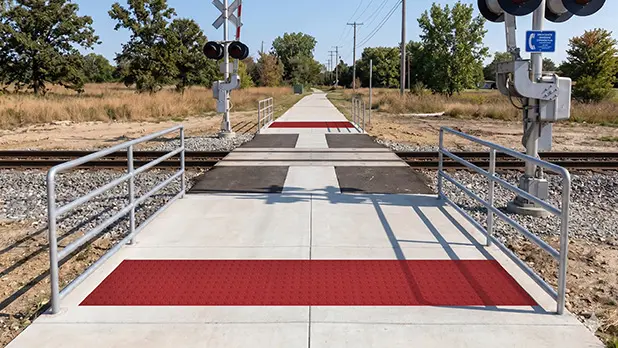
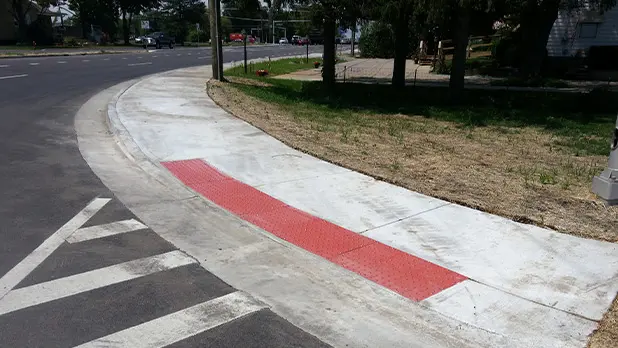
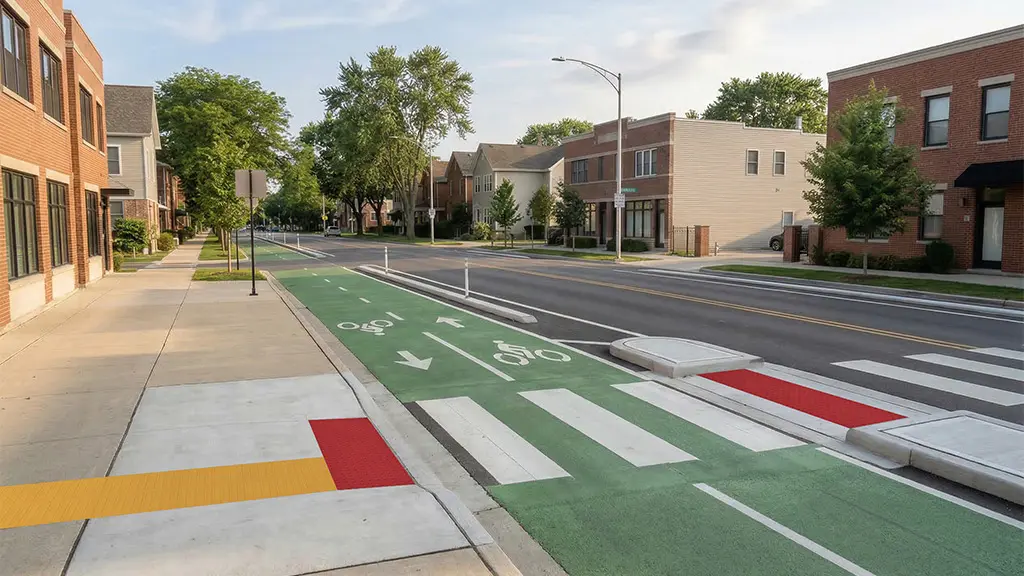
PROWAG establishes accessibility criteria specifically for pedestrian facilities in the public right-of-way. Its provisions address detectable warning surfaces at specified conditions that include curb ramps and blended transitions at pedestrian street crossings, qualifying pedestrian refuge islands, certain rail crossings, transit boarding areas, and specified controlled driveways.
For public-right-of-way work, that broader scoping makes it especially important to review the actual PROWAG provisions rather than relying on a generalized understanding of “ADA requirements.”
The Technical Criteria Are Similar — the Scoping Is the Bigger Difference
The technical characteristics of truncated domes are closely aligned between the two frameworks. Both use the familiar truncated-dome detectable warning pattern and establish dimensional criteria for dome diameter, height, and spacing.
The specified ranges include:
- Base diameter of 0.9 to 1.4 inches
- Top diameter of 50 to 65 percent of the base diameter
- Dome height of 0.2 inch
- Center-to-center spacing of 1.6 to 2.4 inches
- At least 0.65 inch between adjacent dome bases
Both frameworks also address visual contrast between the detectable warning surface and adjacent walking surface.
Where project teams are more likely to encounter differences is in where the warning surface is required, how large it must be, and how it is positioned for the specific condition.
Public Right-of-Way Projects Need Specific Attention
Street and sidewalk projects may involve PROWAG alongside state DOT criteria, municipal standards, agency details, funding requirements, and project-specific specifications.
That makes it risky to carry a detectable-warning detail from one project to another without reviewing the context. Even when the same compliant product can be used, the required warning-field dimensions or placement may differ.
State requirements can also go beyond federal criteria. California, for example, establishes additional requirements for detectable warnings in certain applications.
The project team should therefore identify the authority having jurisdiction and applicable standards before the warning-surface layout is finalized.
Transit Conditions Have Their Own Nuance
Transit environments illustrate why blanket statements about detectable warnings can be misleading.
Applicable ADA transportation provisions address detectable warnings along specified unprotected rail-platform boarding edges, while PROWAG addresses certain transit conditions within the public right-of-way. Individual transit authorities may also maintain standard drawings, approved-product requirements, color criteria, or installation details.
A platform, street-level transit stop, public sidewalk, and station site should not automatically be treated as interchangeable conditions simply because all may incorporate truncated domes.
A Better Compliance Workflow
A more reliable process starts with the project rather than the product.
1. Identify the Facility and Location
Determine whether the work occurs in a public right-of-way, transportation facility, private site, or another environment.
2. Identify the Governing Requirements
Review the applicable federal criteria along with state, local, transportation-agency, owner, and project-specific requirements.
3. Confirm Scoping and Placement
Determine whether a detectable warning surface is required at the location and how the governing criteria address its size and placement.
4. Verify the Technical Criteria
Once the application is understood, confirm truncated-dome geometry, visual contrast, material, installation method, and other specification requirements.
Following that sequence helps prevent the assumption that selecting a technically compliant tile automatically makes the completed installation compliant.
Avoid One-Size-Fits-All Statements
Accessibility standards evolve, and individual jurisdictions or agencies may establish requirements that are more specific than a general federal summary. Project teams should work from current source documents rather than relying on a detail simply because it was used successfully on another project.
The same caution applies to research-based tactile wayfinding guidance. Detectable warning surfaces have established U.S. requirements, while tactile directional indicators (TDIs) and tactile warning delineators (TWDs) do not currently have the same type of national U.S. standards governing their dimensions and use.
For DWS projects, the safest approach is straightforward: identify the governing requirements first, then select and detail the detectable warning system accordingly.