Roundabouts and multilane crossings can simplify vehicle movement, manage traffic flow, or provide alternatives to conventional intersections. From a pedestrian perspective, however, they can introduce a different set of navigation challenges.
At a traditional intersection, the corner itself often provides useful information about where a crossing begins. At a roundabout, a crosswalk may be set back from the intersection and separated from the corner. Multilane crossings can add longer distances, pedestrian islands, multiple traffic streams, and complex geometry.
For pedestrians who are blind or have low vision, those differences can affect how easily a crossing can be located, recognized, and aligned with before entering the street.
Planning for those three tasks individually can help project teams create a more understandable crossing.
Why Roundabouts Can Be More Complex for Pedestrians
A roundabout doesn’t organize pedestrian and vehicle movement in quite the same way as a conventional signalized intersection.
Crosswalks are commonly located away from the circular roadway itself. Depending on the design, a pedestrian may cross an entry lane, reach a splitter or refuge island, and then cross an exit lane before continuing along the sidewalk.
The sounds and movements of traffic are different as well. Vehicles may be approaching, entering, circulating through, or leaving the roundabout rather than simply traveling parallel or perpendicular to the pedestrian.
For someone relying on nonvisual environmental information, these conditions can make some familiar intersection cues less straightforward.
Current tactile-wayfinding research identifies roundabouts, midblock crossings, and channelized turn lanes as environments where crossings may occur in an unexpected location, including some distance from a traditional intersection corner.
That leads to an important design question: How does a pedestrian know where the crossing is?
First: Help Pedestrians Locate the Crossing
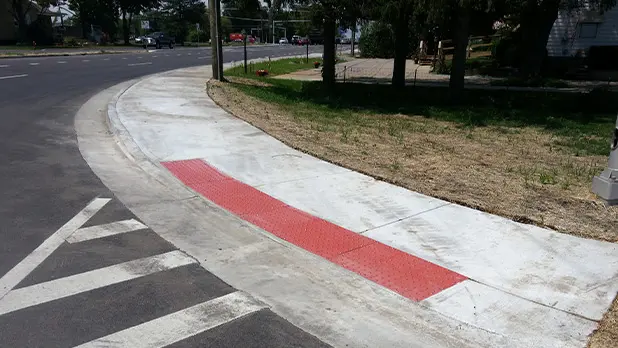
A detectable warning tells a pedestrian about a boundary or hazard once they reach it. It does not necessarily help someone find a crosswalk located farther along a sidewalk.
That distinction is especially relevant at roundabouts.
Research-based tactile guidance describes the use of sidewalk alert TDIs at certain noncorner crossings. These raised-bar surfaces extend across the sidewalk so pedestrians who are blind or have low vision can encounter the tactile cue while traveling along the pedestrian route and use it to locate the crossing.
Location and Warning Are Different Messages
This is an important distinction when planning tactile information.
A raised-bar sidewalk alert can help communicate: There is a crossing here.
The truncated domes of a Detectable Warning Surface (DWS) communicate a different message when the pedestrian reaches the street boundary: You are approaching a vehicular area or other applicable hazard.
Using distinct patterns for distinct purposes allows the tactile information to communicate more than simply adding texture to the pavement.
Because TDI applications at roundabouts are based on current research and agency practices rather than an established national U.S. standard, project teams should confirm whether and how these treatments are being used by the governing agency.
Next: Clearly Identify the Street Boundary
Once the crossing has been located, detectable warnings provide the standardized tactile warning at applicable transitions between pedestrian and vehicular areas.
Truncated domes are designed to be detectable underfoot and with a long cane. At a curb ramp or blended transition, encountering the DWS lets a pedestrian know that the street begins beyond that warning surface.
At a roundabout, that warning function remains important even when other tactile information is being used nearby.
Don’t Ask Truncated Domes to Provide Direction
The dome pattern should not be treated as an arrow or directional surface.
A curb ramp may slope in a direction that does not correspond precisely with the crosswalk. That can occur in many pedestrian environments, but it is particularly worth considering where crossing geometry is skewed or unconventional.
The detectable warning communicates the presence of the boundary. It does not, by itself, tell the pedestrian which direction to cross.
Keeping that function clear helps prevent one tactile treatment from being expected to communicate two different messages.
Crossing Alignment Deserves Its Own Attention
Finding the crossing and finding the street edge still leaves another task: establishing the correct direction of travel through the crosswalk.
At straightforward crossings, curb geometry, traffic sounds, or other environmental information may provide enough orientation. At skewed crossings or locations with complicated vehicle movements, those cues may be less reliable.
Current research-based guidance describes alignment bar TDIs for situations where curb ramps, geometry, or traffic patterns could direct pedestrians away from the intended crossing alignment.
How Alignment Bars Work
For this application, raised parallel bars are arranged as a localized tactile field near the detectable warning. The bars are oriented perpendicular to the direction of travel through the crosswalk so a pedestrian can use the tactile pattern as a physical alignment cue.
At crossings separated from a conventional intersection—including roundabouts—the guidance places this alignment treatment on the downstream side of the crossing relative to approaching traffic.
The exact placement can vary with curb-ramp configuration. Research summarized in the guidance discusses more than one viable approach and does not identify a single placement method as conclusively best for every condition.
That uncertainty is worth preserving in design decisions rather than turning research guidance into a universal detail.
Multilane Crossings Add Distance and Decision Points
Not every challenging multilane crossing is a roundabout.
Wide arterials, divided roadways, channelized turn lanes, and other complex intersections may require pedestrians to navigate several traffic movements before reaching the opposite sidewalk.
Longer crossings can also incorporate medians or pedestrian refuge islands, creating a journey with multiple transitions rather than one continuous movement from curb to curb. Where an island is part of the route, the tactile information should make clear that the crossing continues beyond that intermediate space.
In those environments, accessibility planning benefits from looking at the crossing in sequence:
Approach → Locate → Align → Enter → Refuge → Reorient → Cross → Exit
Each stage may provide different information to the pedestrian.
A detectable warning can identify a transition into a vehicular area. A properly designed refuge can provide a place between crossing segments. An accessible pedestrian signal may provide crossing information where required or provided. Tactile alignment information may be considered where geometry makes the intended direction difficult to establish.
Thinking through that sequence can reveal gaps that aren’t obvious when each curb ramp is designed independently.
Channelized Turn Lanes Present Similar Questions
Channelized turn lanes can create crossing conditions that share some characteristics with roundabouts.
The pedestrian crossing may be separated from the main intersection, and turning vehicles can approach the crosswalk at an angle or from a direction that makes traditional traffic cues more difficult to interpret.
The tactile-wayfinding guidance groups roundabouts, midblock crossings, and channelized turn-lane crossings together in several potential applications because of this shared issue: the pedestrian must locate and orient to a crossing that may not be where a conventional intersection layout would lead them to expect it.
For project teams, that means channelized crossings deserve the same deliberate questions:
- Can pedestrians readily locate the crossing?
- Is the vehicular boundary clearly communicated?
- Does the geometry provide reliable alignment information?
- Are islands or other intermediate spaces understandable?
- Do tactile, audible, and visual cues support rather than contradict one another?
Bicycle Facilities Can Add Another Layer
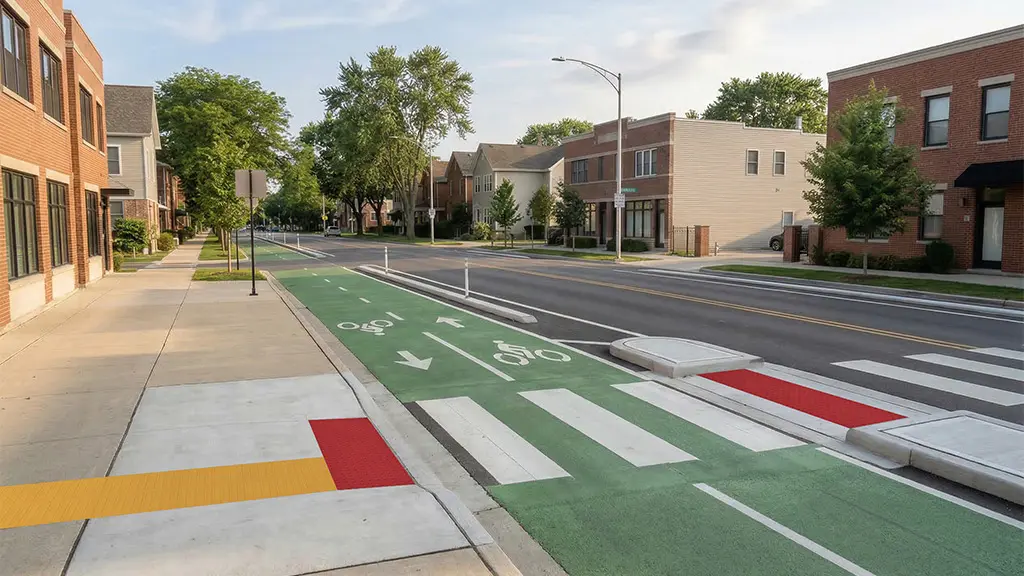
Some modern roundabout designs incorporate shared-use paths or bicycle ramps near the pedestrian route.
This can create an additional wayfinding challenge if a bicycle facility resembles or intersects the route a pedestrian would otherwise follow.
Agency practices continue to evolve in this area. For example, the project guidance documents an application in Florida in which TDIs are used with bicycle ramps at roundabouts to help pedestrians with vision disabilities navigate past the bicycle ramp and continue along the intended pedestrian route.
That example shouldn’t be interpreted as a universal roundabout requirement. It does illustrate why designers need to evaluate what each piece of geometry communicates to someone who isn’t navigating primarily by sight.
Where bicycle and pedestrian facilities interact, tactile treatments should correspond with the actual movement:
- A warning where a pedestrian crosses a vehicular or bicycle path, when applicable
- Directional information where additional guidance is needed
- A distinguishable boundary where adjacent same-grade facilities require separation
The appropriate combination depends on the facility and governing criteria.
Visual and Audible Information Still Matter
Tactile accessibility is only one part of an accessible crossing.
People with low vision may use pavement markings, lighting, color contrast, vehicle movement, and other visual information. Pedestrians who are blind may rely on traffic sounds and accessible pedestrian signals in addition to tactile and environmental cues.
The strongest crossing designs consider whether these sources of information work together.
For example, a tactile alignment cue that points along the crosswalk should correspond with the actual marked crossing. A detectable warning should maintain appropriate visual contrast with adjacent pavement. An accessible pedestrian signal, where applicable, should provide information relevant to the crossing it serves.
The goal isn’t to maximize the number of accessibility features. It’s to avoid conflicting information and make each cue useful for the task it is intended to support.
Plan the Crossing From the Pedestrian’s Point of View
Plans and details make it easy to see an entire roundabout or intersection at once. A pedestrian experiences it very differently: one decision at a time.
That makes a route-based review particularly useful for complex crossings.
Start on the approaching sidewalk and follow the intended pedestrian path. Where does the crosswalk become apparent? What identifies the street boundary? What information establishes crossing direction? If there is an island, is the continuation of the route understandable? What happens at the next crossing segment?
Current tactile-wayfinding guidance also encourages engagement with people who have relevant lived and professional experience, including orientation and mobility specialists, as tactile systems are planned and evaluated.
That perspective can be especially valuable in places where geometry that looks clear on a plan may provide very different information at pedestrian level.
Make Every Crossing Cue Do a Clear Job
Roundabouts and multilane crossings don’t have one universal accessibility solution. Their geometry, traffic operations, islands, bicycle facilities, signals, and pedestrian routes can differ substantially from one project to another.
A useful way to approach that complexity is to separate the pedestrian’s needs:
- Can I find the crossing?
- Can I recognize the boundary with traffic?
- Can I establish the correct direction?
- Can I understand an intermediate island or refuge?
- Can I tell when the crossing is complete?
Detectable warnings, directional or alignment cues, accessible signals, visual information, and physical design can each help answer different parts of that journey.
When those elements are coordinated around the actual pedestrian route, complex crossings can provide clearer information without relying on any single tactile feature to do everything.