Detectable warning tiles spend their service life exposed to conditions that can challenge virtually every exterior building material: sunlight, rain, snow, freeze-thaw cycles, heat, deicing chemicals, dirt, cleaning, pedestrian traffic, and maintenance equipment.
For that reason, detectable warning tile durability depends on more than the tile material alone. Finish, anchors, surrounding concrete, drainage, joints, installation quality, and maintenance all contribute to how a detectable warning surface performs over time.
Outdoor Tactile Surfaces Face Multiple Types of Exposure
Weather rarely acts on one component in isolation.
Water can affect the surrounding concrete and attachment system. UV exposure can affect color or coatings. Freeze-thaw conditions can worsen existing voids or concrete deterioration. Snow and ice can obscure tactile surfaces and introduce mechanical contact from maintenance equipment.
Material selection should account for the combination of conditions expected at the actual site.
How Weather Can Affect DWT Systems
UV Exposure and Color Stability
Sunlight can affect pigments and coatings over time, making color stability more than an appearance issue. Detectable warning surfaces may need to maintain visual contrast with the adjacent walking surface throughout their service life.
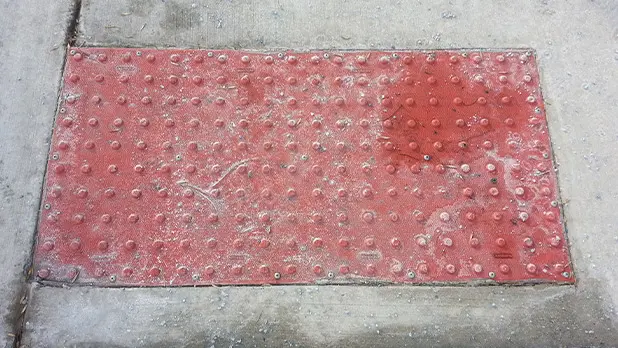
Research has documented sunlight-related fading in certain polymeric DWS products, but that finding should not be generalized to every polymer. Formulations, pigments, finishes, exposure, and maintenance differ among products.
TufTile describes its polymer as using homogeneous color that will not fade and its powder-coated metallic products as having a UV-resistant finish. Current product data and warranty information should be reviewed for the material being specified.
Moisture and Corrosion
Metal products need an appropriate corrosion strategy.
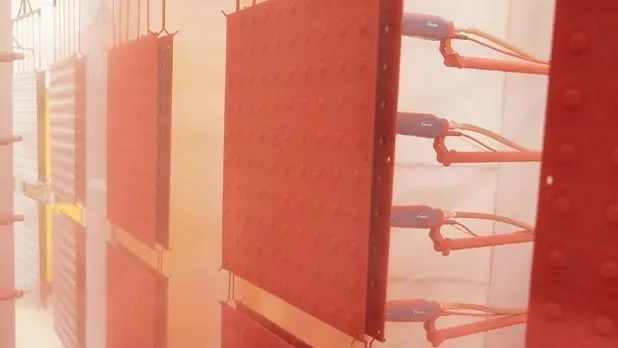
TufTile uses G90 galvanized steel, which applies a zinc coating to the steel substrate for corrosion protection. Its in-house powder-coating process provides an additional finished surface where specified.
Cast iron behaves differently and can be supplied with a finish or left unfinished to develop a natural appearance.
Regardless of material, drainage and edge conditions matter. Standing water and trapped moisture can affect the tile assembly as well as the surrounding concrete.
Freeze-Thaw Conditions
Water that enters voids or deteriorated concrete can expand when frozen and contribute to damage.
TufTile’s flat-back wet-set design is intended to allow concrete to be consolidated beneath the tile without molded cavities that can create pockets. Proper concrete placement, consolidation, drainage, and curing remain essential.
No tile design can compensate for a failing concrete substrate.
Snow and Ice Maintenance
Snow affects both tactile visibility and maintenance operations.
Research summarized in the TCRP guidance found that DWS detectability did not necessarily disappear under a light layer of snow, while raised guidance strips could become difficult to follow when covered.
The guide also cites field research in which cast iron and solid steel performed well where frequent snow removal was expected.
Material is only part of that equation. Snowplows and other equipment can contact raised tactile elements, making maintenance practices and edge conditions important regardless of the product selected.
Polymer, Galvanized Steel, and Cast Iron Respond Differently
Each material offers a different combination of characteristics.
Polymer provides low weight and integral color.
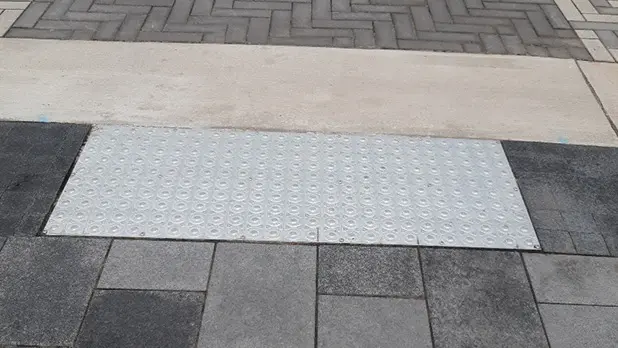
Galvanized steel combines the rigidity of steel with zinc corrosion protection and optional powder coating.
Cast iron provides substantial mass and a different weathering and aging profile.
None is universally the best material for every climate. The appropriate choice depends on exposure, installation method, traffic, maintenance practices, finish expectations, and project requirements.
The Surrounding Pavement Can Be the Weak Link
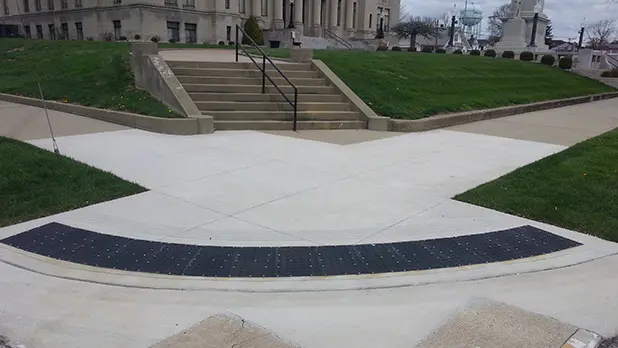
A durable detectable warning tile installed into deteriorating pavement still creates a maintenance problem.
Cracking, settlement, poor drainage, salt scaling, joint deterioration, and freeze-thaw damage can undermine edges or attachment even when the tile material itself remains serviceable.
Lifecycle planning should therefore evaluate the complete ramp, sidewalk, or platform assembly rather than focusing solely on the tactile product.
Specify for the Environment You Actually Have
Climate labels alone are not enough.
Local snow-removal practices, deicing exposure, shade, drainage, pedestrian volume, cleaning, substrate condition, and maintenance capabilities can all affect material performance.
Samples, warranties, and manufacturer technical data can help compare products, but the final specification should reflect the conditions the detectable warning system will actually experience.
Routine inspection then helps preserve both tactile performance and visual contrast as those conditions act on the installation over time.