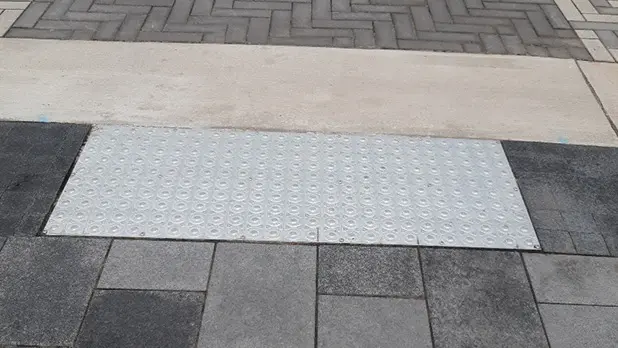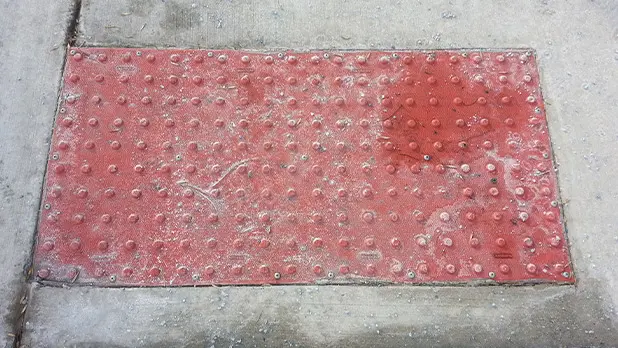
Deicing salts help keep sidewalks, curb ramps, transit platforms, and other pedestrian areas usable during winter weather. Once the snow and ice begin to melt, however, those same materials become part of the environment that outdoor infrastructure must withstand.
Detectable warning tiles are no exception.
Deicing products can dissolve into meltwater, travel across the walking surface, collect around tile edges and joints, and repeatedly contact both the tactile surface and surrounding concrete throughout the winter.
For project teams in cold-weather regions, deicer exposure is worth considering at two different stages: when selecting a detectable warning system and when maintaining it after installation.
What Happens After Deicing Salt Is Applied?
Deicing salt doesn’t remain neatly where it was spread.
As ice and snow melt, dissolved salts can move with water across pavement and into joints, cracks, edges, and other openings. Splash and tracked-in material can extend the area of exposure even farther.
A detectable warning installation therefore isn’t exposed only on the tops of its truncated domes. Depending on the system and site conditions, salt-laden moisture may encounter:
- The tile surface
- Coatings or finishes
- Tile edges
- Fasteners and attachment points
- Joints and sealants
- The concrete immediately surrounding the tile
This is why deicing exposure is best considered as an installation condition, rather than simply a question about the tile material itself.
Why Deicing Salts Matter to Metal Products
Moisture is a fundamental part of corrosion. When salts are present, the environment can become more aggressive for exposed metals.
That doesn’t mean all metal detectable warning tiles will respond the same way. The type of metal, protective treatments, coatings, product construction, and condition of the installed surface all influence how a particular product is designed to perform.
For specifiers considering metal DWTs in locations where deicers are routinely used, corrosion protection is therefore an important product characteristic to understand.
Galvanized Steel Adds a Protective Zinc Layer
TufTile manufactures its galvanized steel detectable warning tiles using G90 galvanized steel.
Galvanizing applies a zinc coating to the steel, providing corrosion protection for the underlying material. TufTile identifies that G90 coating as a key part of the corrosion resistance of its galvanized steel DWTs and positions the material for demanding outdoor applications including municipal and transportation infrastructure.
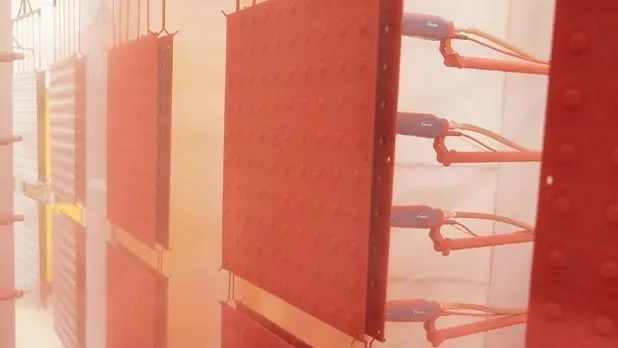
On powder-coated TufTile products, the exterior finish is another part of the overall system. The powder coating provides the finished color and surface characteristics, while the galvanizing beneath it serves a different function.
That layered construction is useful to understand when evaluating what happens if the exterior finish experiences wear during the life of the installation.
Cast Iron Responds Differently From Galvanized Steel
Cast iron doesn’t rely on galvanizing for corrosion protection and should not be evaluated as though it were simply a heavier version of galvanized steel.
Its material composition and surface characteristics are different.
TufTile identifies cast iron warning tiles as a durable option for demanding outdoor infrastructure, particularly transportation facilities, streetscapes, municipal projects, and other new-construction applications. Its project documentation also identifies cast iron among the materials suitable for environments where moisture and deicing salts are performance considerations.
Because different metals weather differently, visible surface changes should be interpreted in the context of the actual material rather than using the appearance of one product as the benchmark for another.
Polymer Removes Metal Corrosion From the Equation
Polymer detectable warning tiles introduce a fundamentally different material response: the tile itself isn’t metal.
TufTile’s polymer products are manufactured from an engineered resin and are described in its product materials as resistant to corrosion, cracking, chipping, and fading.
That makes polymer relevant when corrosion resistance is one of the characteristics being considered for a project.
It does not mean deicing exposure becomes irrelevant to the installation as a whole.
A surface-applied polymer tile still exists within a system that includes concrete, attachment components, edges, sealants, and surrounding pavement. Wet-set polymer similarly interacts with the concrete into which it is installed.
Looking only at whether the tile material itself can corrode misses those other components.
The Surrounding Concrete Matters Just as Much
A detectable warning surface rarely fails or succeeds in isolation from its substrate.
The curb ramp, sidewalk, platform, or other concrete surrounding the tile is exposed to the same winter environment. Meltwater moves across both surfaces, and deicers used to keep the pedestrian route clear may repeatedly contact the concrete around the DWT.
That makes pavement condition an important part of long-term monitoring.
Cracking, scaling, spalling, deteriorating joints, settlement, or damage around the perimeter of a tile can change the condition of the overall installation even when the tactile product itself remains intact.
Water Can Find Existing Weak Points
Edges, joints, cracks, and damaged areas deserve attention because they can provide pathways for moisture.
This becomes particularly relevant in climates where deicer exposure occurs alongside repeated freezing and thawing.
Those are two related—but different—environmental factors. Deicing products introduce chemical exposure, while freeze-thaw cycling places physical demands on wet pavement and infrastructure as temperatures move above and below freezing.
For long-term performance, the complete assembly has to live with both.
Where Salt-Laden Moisture Can Reach the Installation
Deicer exposure is not limited to the tile face.
In surface-applied systems, salt-laden moisture may reach perimeter edges, fasteners, sealant, and the concrete substrate. In wet-set systems, the surrounding concrete and the tile-to-concrete relationship remain part of the exposure environment.
Edges, joints, cracks, and damaged areas can provide pathways for moisture. Repeated deicer exposure alongside freeze-thaw cycling makes those conditions especially important to monitor over time.
More Deicer Isn’t Necessarily Better Maintenance
The goal of winter maintenance is to keep pedestrian areas usable, not simply to apply as much deicing product as possible.
The appropriate product, application rate, timing, and method depend on the facility’s maintenance program, weather conditions, pavement, and the deicer being used.
From the standpoint of detectable warning infrastructure, one useful principle is straightforward: avoid unnecessary chemical exposure while still maintaining the pedestrian route appropriately.
That may include following the deicing product manufacturer’s application guidance, avoiding excessive accumulation, and removing residual material as part of routine site maintenance when appropriate.
Project teams should rely on the recommendations applicable to the particular pavement, deicing product, detectable warning system, and facility rather than assuming one universal winter-maintenance practice applies everywhere.
Don’t Forget What Gets Tracked Into the Site
Not all deicer exposure comes from material intentionally spread directly on a detectable warning surface.
Salt and other winter residue can be carried by pedestrian footwear, mobility devices, maintenance equipment, runoff, snow piles, vehicle splash, and more.
That matters in places such as transit facilities, building entrances, parking structures, campuses, and other high-use environments where winter residue can migrate well beyond its original application point.
It also means an installation may experience deicer exposure even when maintenance crews intentionally avoid spreading product directly over the DWT.
The larger site drainage and cleaning plan can therefore matter as much as application practices immediately around the tile.
Residue Can Hide What You Need to See
Winter leaves behind more than moisture.
Salt residue, sand, grit, dirt, and other material can collect around and between truncated domes. Over time, that buildup can obscure the surface and make it more difficult to evaluate its actual condition.
Routine cleaning gives maintenance teams a clearer view of:
- Truncated-dome condition
- Tile edges
- Coatings and finishes
- Fasteners
- Joints or sealant
- Adjacent concrete
A white film or discoloration on the surface, for example, shouldn’t automatically be interpreted as product deterioration without first determining whether it is removable residue.
Cleaning before inspection makes it easier to distinguish what is on the tile from what has happened to the tile.
Look at the Installation Again When Winter Ends
Spring is a useful time to evaluate what a detectable warning system experienced during the previous winter.
Once snow, ice, and accumulated residue are gone, inspect the area as a complete assembly.
Post-Winter Conditions to Review
Pay attention to:
- Changes in the tactile surface
- Coating or finish damage
- Corrosion or material deterioration
- Loose components or fasteners
- Changes at tile edges
- Cracked, scaled, or spalled surrounding concrete
- Failed joints or perimeter conditions
- Areas where water routinely collects
Compare what you find with earlier inspection records when available.
A condition that appears suddenly after one winter may suggest a specific event or exposure. Gradual change over several seasons tells a different maintenance story.
Winter Performance Is a System Question
Deicing salt may first seem like a material question: Will this tile tolerate salt?
In practice, the better question is broader: How will this entire installation perform in an environment where deicers are routinely used?
The answer involves the tile material, protective finishes, attachment or anchoring system, surrounding concrete, drainage, installation quality, cleaning, inspection, and winter-maintenance practices.
Considering those pieces together helps project teams plan for the environment the detectable warning surface will actually experience—not just the conditions present on installation day.