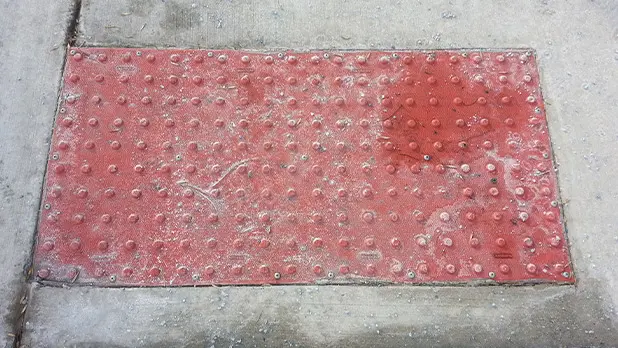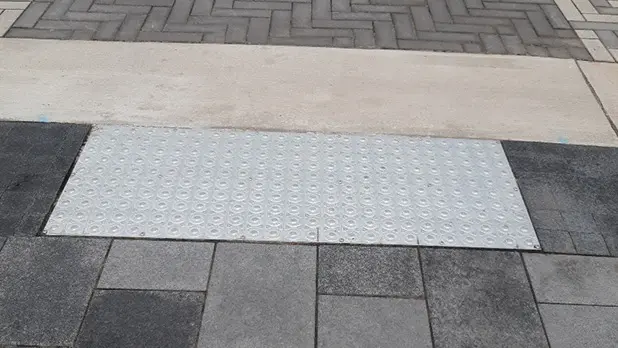
Strength, durability, color, installation method, and material performance tend to get most of the attention when choosing detectable warning tiles. Weight is easier to overlook.
Yet the difference between two products can be substantial. Depending on the material, gauge, and tile size, one detectable warning tile may weigh only a few pounds while another of the same dimensions weighs several times as much.
Once dozens or hundreds of tiles are moving through a project, that difference can affect shipping, unloading, staging, handling, positioning, and installation.
Tile weight shouldn’t determine material selection on its own. But understanding where it affects the job can help project teams make a more complete product comparison.
Detectable Warning Tile Weight Can Vary Significantly
There isn’t a standard weight for a detectable warning tile. Material is an obvious factor, but thickness, size, configuration, and product design also contribute.
TufTile’s product line provides a useful example. Consider the published weights for a standard 2′ × 2′ tile:
| TufTile Product | Approx. Tile Weight |
|---|---|
| Polymer | 5.1 lbs. |
| 16-gauge galvanized steel | 10 lbs. |
| 10-gauge galvanized steel | 22 lbs. |
| Cast iron | 37 lbs. |
These aren’t equivalent products differentiated only by weight. Each material has its own construction, performance characteristics, installation options, and applications. But the comparison illustrates just how wide the weight range can be within the same basic tile footprint.
For a single tile, the difference may seem relatively small. Across an entire shipment and installation, it becomes much more noticeable.
Weight Begins to Matter Before the Tiles Reach the Jobsite
The logistical impact of tile weight starts well before installation.
Product weight contributes to the total weight of cartons or pallets moving from the manufacturer to the project. It can influence how material is packaged, transported, unloaded, stored, and moved again when crews are ready to install it.
TufTile’s submittal documents include both individual tile weights and packaging specifications, giving contractors and project teams information they can use when planning material handling.
Think Beyond the Weight of One Tile
Logistically, it’s often better to assess how much material is being moved for the entire installation.
A project involving numerous curb ramps, platforms, or pedestrian crossings can require a significant quantity of tactile surface material. Even if every individual component can be handled comfortably, differences in total shipment weight can affect the amount of material being moved throughout the job.
TufTile specifically identifies lower weight as one advantage of its galvanized steel detectable warning tiles compared with cast iron, citing easier installation and greater shipping efficiencies.
Lighter Tiles Can Simplify Jobsite Handling
Once material arrives, tiles may need to move through several stages before they reach their final location.
They can be unloaded from pallets, staged near work areas, carried to individual curb ramps, repositioned during layout, and handled again during installation.
Lower weight can make those movements easier.
This can be particularly useful on projects where tactile surfaces are being installed at many separate locations rather than in one concentrated work area. A streetscape or municipal sidewalk project, for example, may require crews to move material from one intersection or curb ramp to the next as work progresses.
Tile Size Changes the Handling Equation
Looking only at pounds per square foot can also hide what a crew actually handles.
A larger tile covers more area, but it also concentrates more material into one component. TufTile’s 10-gauge galvanized steel wet-set line, for example, ranges from a 5.5-pound 1′ × 1′ tile to a 58-pound 2′ × 5′ tile.
The 16-gauge line is considerably lighter: TufTile lists its 2′ × 5′ wet-set tile at 29.5 pounds.
Those differences are useful to know before installation begins. Product size, crew planning, site access, and handling requirements can all be considered together rather than discovering the practical implications once material is already in the field.
Weight Can Affect Positioning During Installation
Detectable warning tiles need to be placed accurately. Their location, orientation, alignment, and relationship to adjacent tiles or pavement are part of the finished installation.
That means crews may need to make small adjustments as a tile is positioned.
With wet-set products, the tile is being incorporated into fresh concrete. With surface-applied systems, tiles must be positioned on an existing surface before or during the fastening process. In either case, the ability to handle and position the component efficiently can matter during installation.
A lighter tile doesn’t automatically make an installation better, and a heavier tile doesn’t make it worse. The point is simply that material weight becomes part of the installation process, especially as tile dimensions increase.
Contractors evaluating products can therefore look beyond whether a material is technically installable and consider how its weight fits the crew, equipment, access, and sequencing planned for the job.
Galvanized Steel Offers More Than One Weight Profile
Material categories don’t always tell the whole story.
TufTile offers galvanized steel detectable warning tiles in both 10-gauge and 16-gauge options. Though they are the same material, because gauge affects the thickness of the steel, the two products have different weights. That gives project teams another variable to evaluate within the galvanized steel category itself.
TufTile’s existing product documentation lists approximate weights of 5.5 pounds per square foot for 10-gauge galvanized steel and 2.5 pounds per square foot for 16-gauge galvanized steel.
Heavier Isn’t Automatically Better
It’s tempting to treat weight as shorthand for durability: if one product is heavier, it must be the better product.
That isn’t a reliable way to specify a detectable warning system.
A heavier material may offer characteristics that are desirable for a particular project. Cast iron, for example, is a substantial material commonly used in demanding municipal, public works, and transportation applications. TufTile’s 10-gauge galvanized steel likewise provides a heavier steel option where that product’s characteristics align with the project.
But lower-weight products can also be engineered for demanding applications. TufTile describes its galvanized steel line as providing long-term durability for heavy pedestrian traffic, high-abuse areas, and snow-removal conditions while being approximately half the weight of cast iron.
Weight is therefore a product characteristic, not a performance rating.
Lightweight Doesn’t Mean One Material, Either
Polymer represents the lightest option within TufTile’s detectable warning line. Its current submittals list a 2′ × 2′ polymer tile at approximately 5.1 pounds and a 2′ × 5′ tile at approximately 13 pounds.
The material also differs from metal tiles in ways unrelated to weight, including its integral color and material composition.
This reinforces an important point: choosing a lightweight detectable warning tile doesn’t identify a single product solution.
A project could be comparing polymer with galvanized steel, or evaluating different gauges within the galvanized steel category. Installation method can narrow those choices further. TufTile offers polymer and galvanized steel in both wet-set and surface-applied configurations, while its cast iron products are wet-set.
The useful question isn’t simply “Which tile weighs the least?”
It’s “How important is weight for this project, and which products meet the rest of our requirements?”
Where Does Weight Matter Most?
Weight may deserve more attention on some projects than others.
Projects with Many Installation Locations
Municipal sidewalk programs, streetscape projects, and accessibility upgrades can involve numerous curb ramps spread across a large area. Material that needs to be repeatedly loaded, unloaded, staged, and carried between locations makes handling efficiency more relevant.
Large-Format Tile Installations
As individual tile dimensions increase, so does the weight of each component. Reviewing actual product weights can help contractors understand what crews will be positioning rather than relying on a general description such as “steel” or “polymer.”
Retrofit Projects
Existing-site conditions can make material movement less straightforward than on an open new-construction site. Limited access, active pedestrian areas, existing landscaping, buildings, or other constraints may influence how products reach the installation area.
Projects with Significant Shipping Volume
For larger orders, differences in individual tile weight accumulate across pallets and shipments. Packaging specifications can help project teams anticipate the total material being delivered and plan accordingly.
Compare Actual Products, Not Assumptions
Terms like lightweight, heavy-duty, steel, and cast iron can create quick impressions about how a product will behave. Technical documentation provides a better basis for planning.
Before selecting or ordering detectable warning tiles, project teams can review the manufacturer’s submittal or product data for the specific material, size, gauge, and installation configuration being considered.
That makes it possible to compare real numbers.
For contractors, those numbers can inform shipping, staging, crew planning, and field handling. For designers and specifiers, they provide another practical characteristic to weigh alongside material performance and project requirements.
Choose the Weight That Fits the Whole Project
Tile weight isn’t usually the first characteristic that determines whether a detectable warning product is right for a project. But it can have practical consequences from the moment material is shipped until the final tile is positioned.
Understanding those consequences allows project teams to account for logistics and constructability alongside durability, installation method, accessibility requirements, maintenance, and long-term performance.
The goal isn’t necessarily to choose the lightest or heaviest tile. It’s to understand what you’re asking crews to move and install, and whether that product makes sense for the project as a whole.