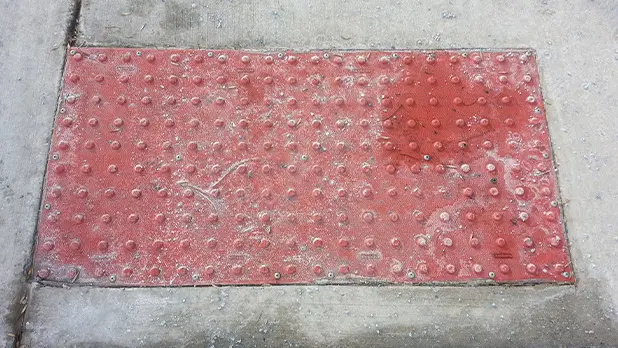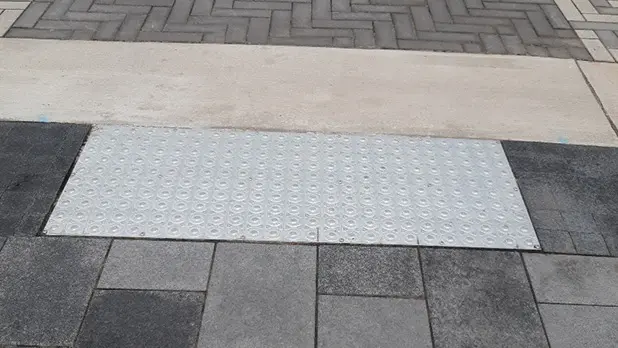
Two detectable warning tiles may be specified in a similar color and still get that color in very different ways.
With a polymer tile, the color is part of the material itself. With a galvanized steel tile, color comes from a powder-coated finish applied over the metal. That difference is worth understanding when comparing products, reviewing submittals, or selecting a material for a project.
It doesn’t change the need to meet applicable visual-contrast requirements, but it does change what you’re looking at when you review the product.
Polymer: Color Throughout the Material
TufTile polymer detectable warning tiles use homogeneous color throughout the tile rather than relying on a colored surface coating.
In practical terms, the material and the color aren’t separate layers. When reviewing a polymer product, the selected color should therefore be confirmed along with the exact tile material, dimensions, and installation configuration.
That distinction can also be useful when comparing products from different manufacturers. A color name by itself doesn’t tell you how the product is manufactured or how that color is incorporated into the material.
The current product submittal should be the reference for the exact polymer product being specified.
Galvanized Steel: A Powder-Coated Finish
Powder-coated warning tiles use a different material system than polymer tiles.
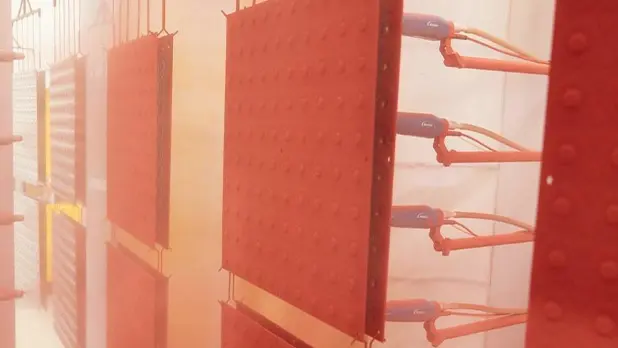
TufTile’s galvanized steel detectable warning tiles use G-90 galvanized steel and receive a powder-coated finish in-house. The powder coating provides the selected color while also serving as the finished surface of the tile.
TufTile’s powder-coating process helps provide UV and abrasion resistance as well as slip-resistant performance. Because the coating is part of the finished galvanized steel system, the product submittal should identify both the base material and the selected finish.
This is one reason “What color is it?” isn’t quite enough when comparing detectable warning tiles. For galvanized steel, you’re also choosing the material beneath that color and the finish applied to it.
Material and Installation Still Matter
Color shouldn’t be evaluated separately from the rest of the product decision.
TufTile offers polymer and galvanized steel products in different installation configurations. The appropriate choice depends on the project conditions, including whether the installation involves new or existing concrete and which product characteristics the project requires.
A submittal review should therefore confirm the complete product—not simply a color chip. Check the material, dimensions, installation method, finish or color, and current installation instructions for the product being proposed.
That makes it easier to compare like with like when multiple options are being considered.
Visual Contrast Is the Bigger Color Question
Regardless of how a detectable warning tile gets its color, the finished installation still needs to meet the visual-contrast criteria that apply to the project.
Where PROWAG applies, detectable warning surfaces must contrast visually with adjacent walking surfaces, either light-on-dark or dark-on-light.
That means a color can’t really be evaluated by itself.
A tile sample sitting on a desk may look dramatically different once it is placed next to light concrete, dark asphalt, brick pavers, or another paving material. Screen colors are even less reliable because displays, photography, and lighting can all change how a color appears.
Before finalizing the selection, compare a physical sample with the actual or proposed surrounding pavement whenever possible. Look at the combination under lighting conditions representative of the site.
And if the pavement selection changes later in the project, revisit the detectable warning color. A combination that provided a clear contrast against the original paving may not perform the same way against the replacement.
Know What You’re Comparing
Polymer and powder-coated galvanized steel aren’t simply two ways to get the same colored tile. They are different material systems, and color is incorporated into each one differently.
Understanding that distinction makes product submittals easier to evaluate and helps keep the color decision connected to the larger questions that matter: material, installation, finish, durability, and visual contrast with the surrounding walking surface.