Material selection for detectable warning tiles involves more than choosing between metal and nonmetal products. Weight, color, installation method, climate, traffic, maintenance, and replacement strategy can all influence which material makes sense for a particular project.
Polymer detectable warning tiles offer a lightweight, nonmetallic option with integral color and flexibility for both new construction and retrofit applications. As with any detectable warning material, however, performance depends on the specific product and the environment where it will be installed.
Where Polymer Fits in the Detectable-Warning Market
Polymer tiles can provide a durable truncated-dome surface at substantially less weight than metallic alternatives. Depending on the product, polymer systems may also offer integral color, replaceability, and options for wet-set or surface-applied installation.
Those characteristics can make polymer attractive for a broad range of curb ramps, sidewalks, pedestrian routes, and other detectable-warning applications.
The word polymer, however, describes a broad material category. Formulation, reinforcement, anchoring, UV stability, tile design, and manufacturing methods can differ among products. Specifications should therefore evaluate the actual product rather than assume all polymer detectable warning tiles will perform identically.
Understanding TufTile’s Polymer System
Proprietary Polymer Construction
TufTile describes its polymer as a high-impact proprietary resin engineered not to bloom, crack, or fade. The material is also replaceable and recyclable.
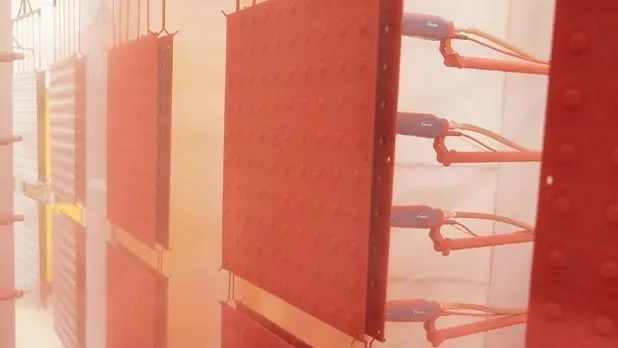
Unlike a surface finish applied over another base material, the color is homogeneous throughout TufTile’s polymer. This means normal wear or scratching does not expose a differently colored substrate beneath the surface.
A Lightweight Material Option
TufTile lists its polymer detectable warning tile at approximately 1.8 pounds per square foot, making it considerably lighter than its galvanized-steel and cast-iron products.
That difference can simplify shipping, jobsite handling, and positioning, particularly when larger tile sizes are involved. Weight should not determine the specification by itself, but it is a legitimate constructability and logistics consideration.
Wet-Set and Surface-Applied Configurations
Another practical advantage is installation flexibility.
TufTile polymer tiles are available in wet-set configurations for fresh concrete and surface-applied configurations for suitable cured surfaces. This allows polymer to be considered for new construction as well as retrofit and replacement projects.
The two installation methods are not interchangeable. Wet-set systems must be coordinated with concrete placement and finishing, while surface-applied systems depend on substrate preparation, drilling, anchoring, and sealing. Contractors should follow the current instructions for the specific system selected.
Integral Color and Visual Contrast
Because color runs through the polymer material, it does not depend on a powder-coated top layer to establish its initial appearance.
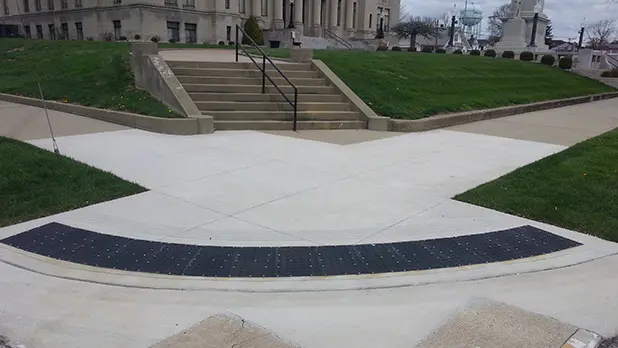
That does not eliminate the need to evaluate color carefully. Detectable warning surfaces need to provide the visual contrast required for the project, and the appropriate color depends on the adjacent walking surface.
A polymer tile that provides strong contrast against one pavement color may provide insufficient distinction against another. Color selection should therefore be based on the complete surface relationship rather than the tile viewed by itself.
Weather, UV Exposure, and Maintenance
Outdoor detectable warning tiles are exposed to sunlight, precipitation, temperature changes, snow, ice, cleaning, and pedestrian traffic. Those conditions should be considered when comparing materials.
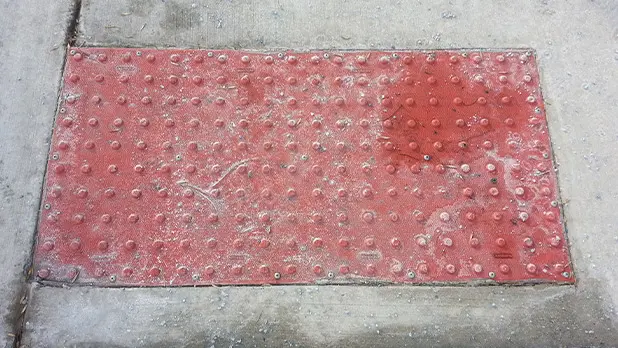
Research into tactile walking surface materials has documented sunlight-related fading in certain polymeric products, but that finding should not be generalized to every polymer formulation. Different resins, pigments, manufacturing processes, exposure conditions, and maintenance practices can produce different results.
TufTile positions its proprietary polymer as resistant to fading and cracking. Project teams should review current product data, warranty information, and applicable agency acceptance criteria when evaluating performance for a particular environment.
Routine inspection still matters. Edges, anchors, surrounding pavement, accumulated debris, and the continuing visual contrast of the warning field should be included in long-term maintenance.
When Polymer May Be a Good Fit
Polymer detectable warning tiles may be worth considering when a project prioritizes:
- Lower product weight
- Integral color
- Nonmetallic construction
- Replaceability
- Wet-set or surface-applied installation flexibility
- A range of color options for visual contrast
Those characteristics should still be weighed against climate, substrate, traffic, maintenance practices, installation conditions, owner preferences, and project specifications.
Polymer, galvanized steel, and cast iron each bring different characteristics to a detectable warning system. The right material is the one that best aligns with the complete project—not simply the one with the strongest single selling point.