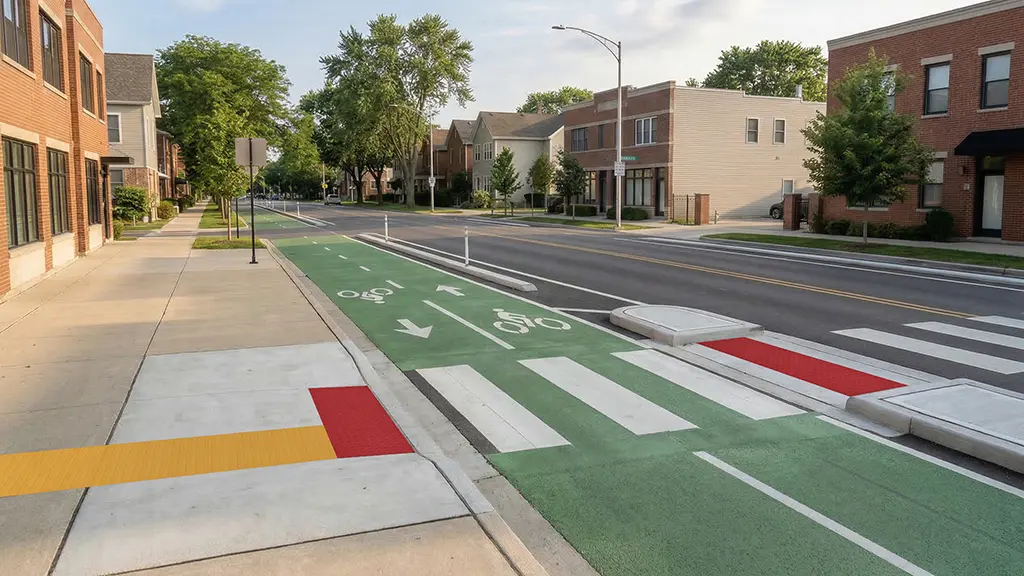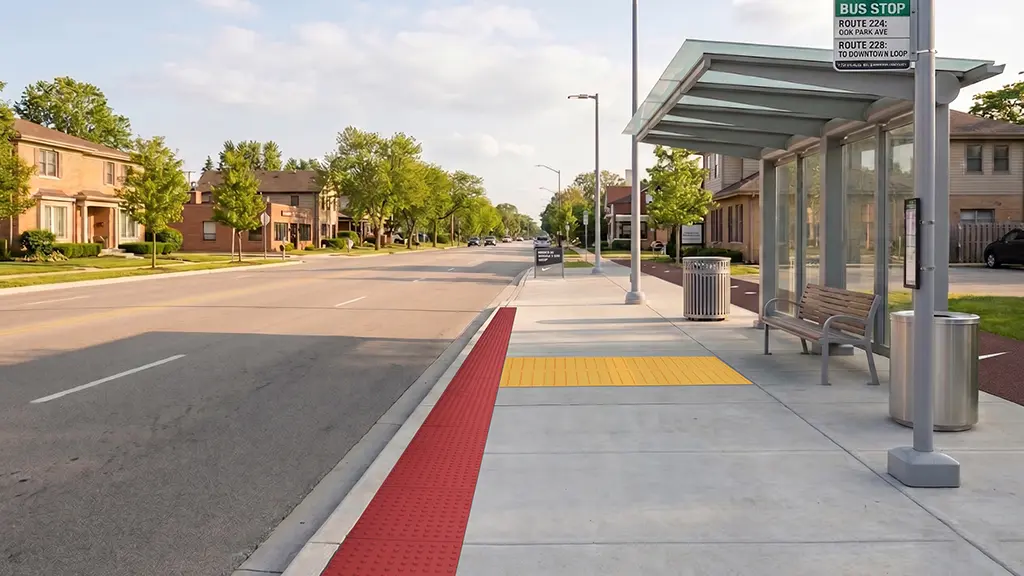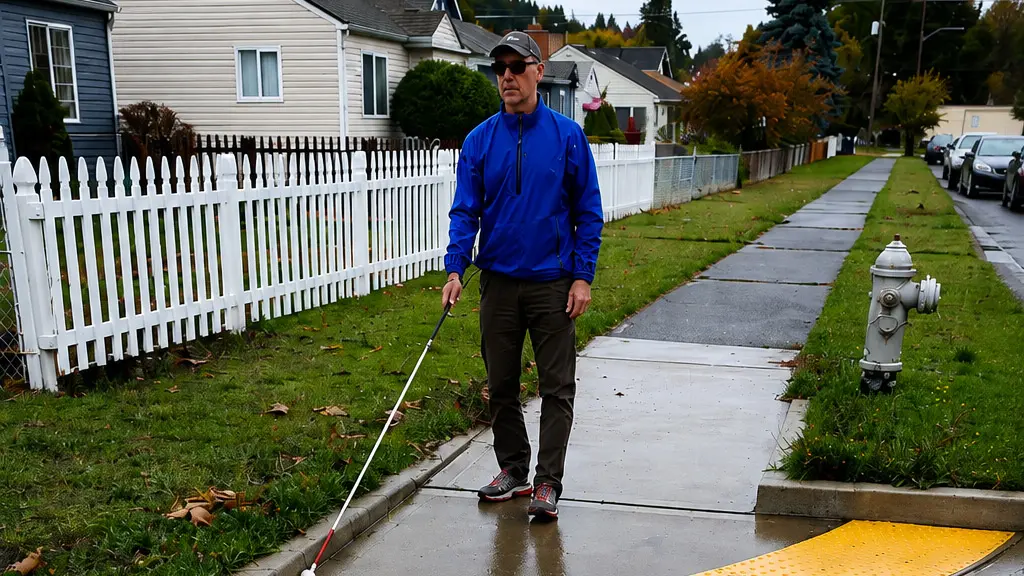
Navigating a pedestrian environment involves gathering information constantly: Where does the sidewalk continue? Where is the street? Is there an edge or boundary ahead? Which direction does the route take?
People who are blind or have low vision may gather that information through a combination of touch, sound, remaining vision, environmental features, a long cane, a guide dog, accessible signals, technology, and other cues. Tactile walking surface indicators add another source of information by creating recognizable changes in the walking surface.
But simply being able to feel a tactile surface isn’t enough. For that surface to be useful, a pedestrian also needs to be able to recognize that it is different from the surrounding pavement and then understand what the particular pattern is intended to communicate.
Tactile Surfaces Are One Part of Wayfinding
Tactile surfaces don’t replace the many other ways people who are blind or have low vision navigate an environment.
Pedestrians may use curbs, building edges, landscaping, changes in pavement texture, traffic sounds, accessible pedestrian signals, signs, landmarks, and other environmental information to understand where they are and where they need to go.
In many environments, these existing cues provide useful information naturally. Tactile wayfinding surfaces can supplement them where a transition or hazard needs to be identified or where natural cues are absent, insufficient, or potentially confusing.
This is why accessible wayfinding is best considered as a system of information, rather than relying on any single product or feature.
How Are Tactile Surfaces Detected?
Different pedestrians interact with tactile surfaces in different ways. Research and guidance for tactile walking surface indicators emphasize multiple forms of detection rather than assuming everyone experiences the surface identically.
Detection Underfoot
A raised tactile pattern creates a physical change from the surrounding walking surface that may be detected as a pedestrian walks across it.
The shape, height, spacing, width, and arrangement of the tactile features all influence how noticeable the surface is. The surrounding pavement matters too. A distinct tactile treatment may be easier to recognize against a relatively smooth walking surface than within an environment already filled with joints, seams, pronounced textures, or other surface variations.
Detection with a Long Cane
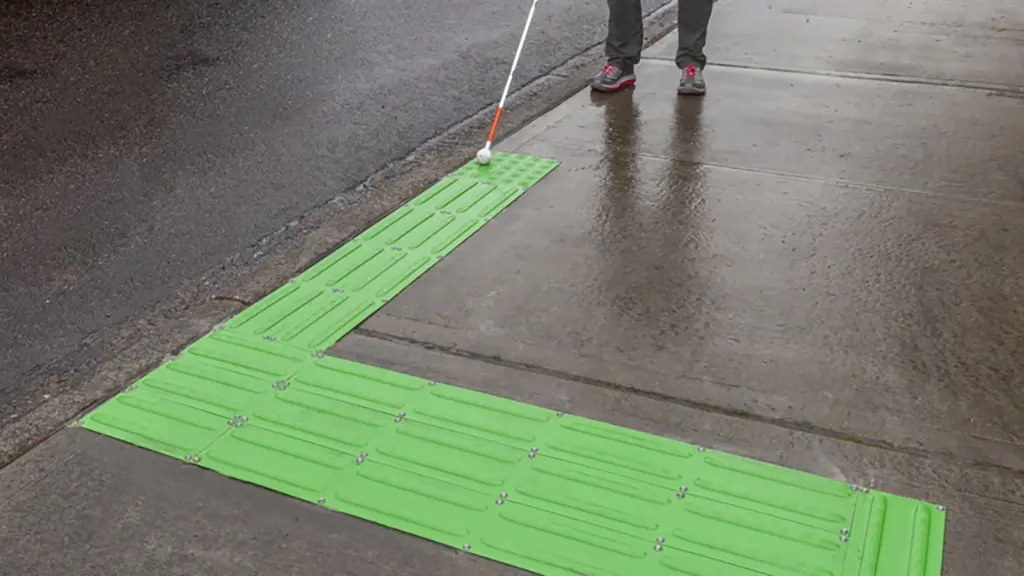
A long cane can provide tactile information about the walking surface ahead of the pedestrian.
As the cane contacts and moves across a raised tactile pattern, the change in surface texture or profile can provide information that differs from the adjacent pavement. Research into detectable warning surfaces has specifically evaluated whether tactile patterns can be reliably detected with a long cane as well as underfoot.
Detection through Visual Contrast
Blindness is a spectrum, and many people who are legally blind retain some usable vision. Visual information can therefore remain an important part of navigation for some pedestrians.
Contrast between a tactile surface and the surrounding walking surface can help make a transition easier to identify visually. For detectable warning surfaces, applicable federal accessibility criteria address light-on-dark or dark-on-light contrast rather than requiring one universal color.
Visual contrast doesn’t replace the tactile pattern. Instead, the two work together to make the surface recognizable to pedestrians who navigate using different combinations of tactile and visual information.
Detectability Is Only Half of the Equation
One of the most useful concepts in understanding tactile surfaces is the distinction between detectability and discriminability.
Detectability asks: Can the pedestrian tell that a tactile surface is there?
Discriminability asks: Can the pedestrian distinguish that surface from other tactile patterns and understand the message it represents?
Both matter.
Imagine an environment containing several raised surfaces that all feel noticeably different from ordinary pavement but are used inconsistently. A pedestrian may detect every one of them successfully and still have difficulty determining what each one means.
That is why tactile patterns should have deliberate, predictable functions.
Different Tactile Patterns Communicate Different Information
Not every tactile surface is a detectable warning surface. Different patterns can be used to communicate different types of information.
Truncated Domes: Warning
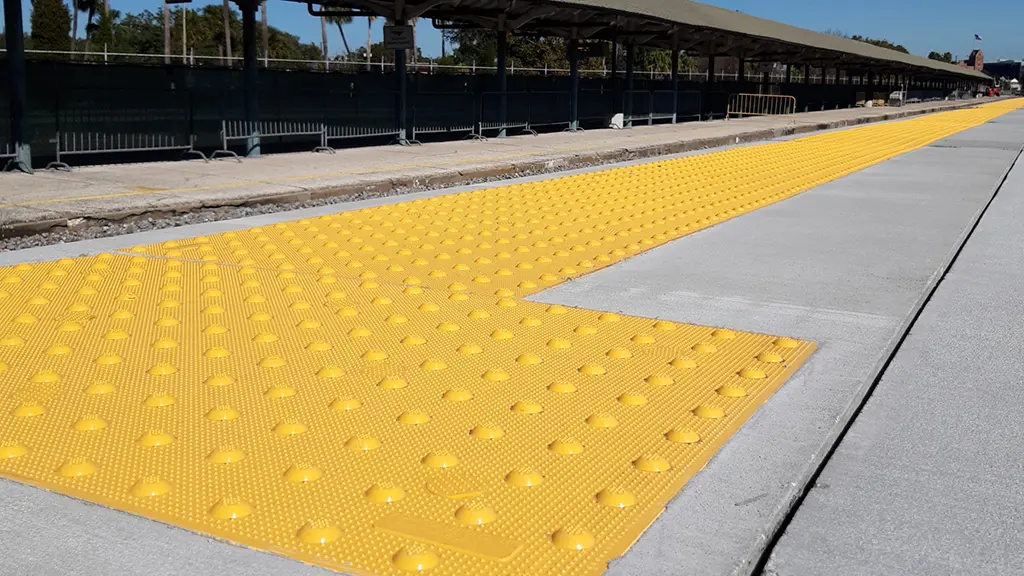
Detectable Warning Surfaces (DWSs) use raised truncated domes to provide a recognizable warning.
In applicable locations, encountering this standardized pattern alerts a pedestrian to a transition or hazard that may not otherwise be readily detectable. Research supporting the use of truncated domes has included curb-ramp applications, where detectable warning surfaces improved detection of the street by blind pedestrians.
The key message is warning. Truncated domes are not intended to function as a continuous directional pathway.
Raised Bars: Guidance and Alignment
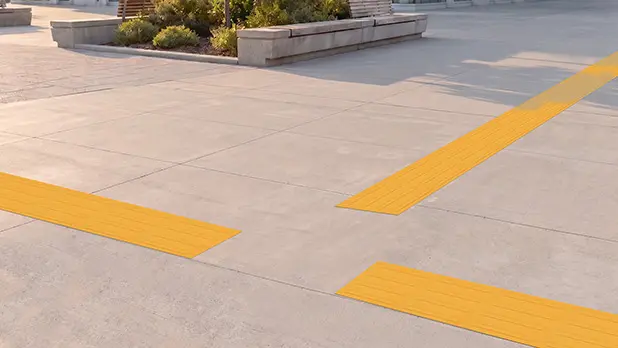
Tactile Direction Indicators (TDIs) use raised parallel bars rather than truncated domes.
Depending on their configuration and the project, raised-bar surfaces can provide information related to direction, alignment, orientation, or location. A pedestrian may detect the bars underfoot or with a long cane and use their orientation as one source of wayfinding information.
Unlike detectable warning surfaces, TDIs do not currently have established national U.S. standards governing their dimensions and use. Their application should therefore be distinguished from federally standardized truncated-dome detectable warnings.
Tactile Delineation: Boundaries
A third tactile message is delineation.
Tactile Warning Delineators (TWDs) use a raised trapezoidal profile to identify a boundary where a pedestrian path is adjacent at the same grade to a bicycle, rail, or motor-vehicle path and there is no intended crossing point along that boundary.
The intended message is different from both warning and guidance: recognize this boundary and remain on the pedestrian side.
Initial research described in current U.S. guidance found the tested trapezoidal delineator highly detectable both underfoot and with a long cane.
Why Consistency Makes Tactile Information More Useful
A tactile pattern becomes more useful when its meaning is predictable.
If truncated domes consistently communicate a warning, raised bars consistently provide directional or alignment information, and delineators consistently identify a boundary, pedestrians can interpret each cue within the larger environment.
If the same tactile pattern is used to mean different things from one location to another, that predictability is weakened.
Consistency matters not only within a single project, but across pedestrian environments. Current U.S. tactile-wayfinding research emphasizes the importance of maintaining distinguishable tactile messages because pedestrians who are blind or have low vision cannot rely on many of the visual cues available to sighted travelers.
For project teams, that means the question shouldn’t simply be: Where can we add a tactile surface?
A better question is: What information does a pedestrian need at this point, and which cue communicates that information clearly?
The Surrounding Environment Matters, Too
Even a correctly designed tactile surface exists within a larger physical environment.
Adjacent pavement texture, seams, cracking, changes in material, lighting, visual contrast, nearby obstacles, and other features can affect how easily tactile information is detected or interpreted.
Natural wayfinding cues should also be considered. A building edge or curb may already provide a clear feature to follow, while a large open plaza may offer very few tactile landmarks.
This is one reason tactile wayfinding should begin with the pedestrian journey, rather than with the product. Understanding origins, destinations, decision points, hazards, boundaries, and transitions can help project teams identify where additional tactile information may be useful and what message it needs to communicate.
Designing for Recognition, Not Just Detection
The purpose of a tactile surface isn’t simply to create something a pedestrian can feel.
Effective tactile information needs to be noticeable, distinguishable, and meaningful within its surroundings. A detectable warning should communicate warning. A directional cue should provide useful wayfinding information. A delineator should identify a boundary.
When those messages remain distinct and predictable—and work alongside the other tactile, visual, audible, and environmental cues available along the route—they can contribute to a pedestrian environment that is easier to understand and navigate.