Tactile Warning Delineators (TWDs) and Tactile Direction Indicators (TDIs) both use elongated raised forms, so the terminology can be easy to confuse. Their functions, however, are fundamentally different.
A TWD defines a boundary that a pedestrian should not cross at that location. A TDI provides guidance, alignment, orientation, or location information. Keeping those messages distinct is essential when multiple tactile walking surface indicators are used within the same environment.
Two Linear Patterns With Different Purposes
What a Tactile Warning Delineator Does
A TWD uses a raised trapezoidal profile to delineate a boundary where a pedestrian path and a bicycle, rail, or motor-vehicle path are adjacent at the same grade and no crossing point exists along that boundary.
Its message is essentially: a hazard exists on the opposite side; remain on the pedestrian side at this location.
What a Tactile Direction Indicator Does
A TDI uses parallel raised bars to provide route, location, alignment, or orientation information.
Depending on the configuration, TDIs can help pedestrians follow a path through an open area, locate a difficult-to-find crossing or transit stop, establish crossing alignment, or identify a transit boarding location.
They do not inherently communicate “do not cross.”
TWD vs. TDI in Simple Terms
The easiest distinction is:
TWD = boundary
TDI = direction or guidance
A delineator identifies an edge or separation. A directional indicator helps a pedestrian determine where to travel, where something is located, or how to align.
Both may be used within one larger tactile system, but their similar linear appearance does not make them interchangeable.
How They Differ From Detectable Warning Surfaces
Detectable warning surfaces introduce a third tactile message.
DWS = warning
TDI = guidance
TWD = no-cross boundary
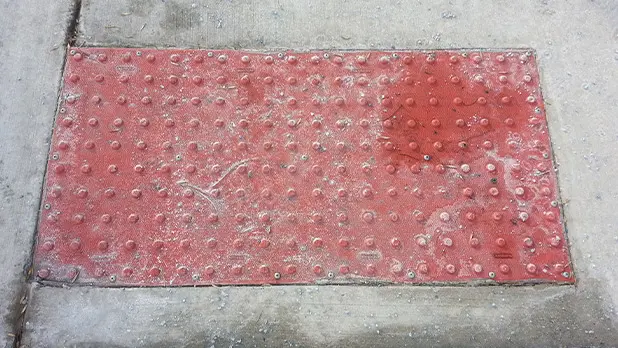
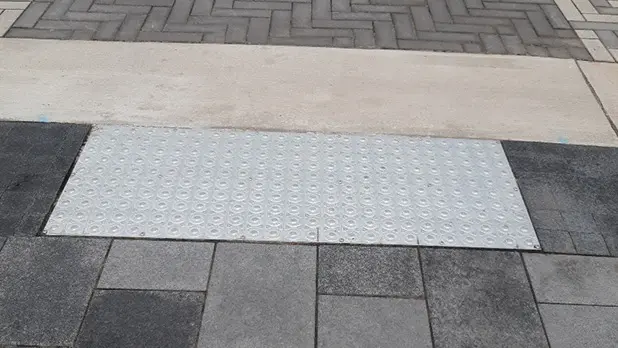
A DWS uses standardized truncated domes to warn that a hazard or transition lies beyond the surface at a location that may be entered or crossed when appropriate.
This differs from a TWD, which delineates a same-grade boundary where the pedestrian is intended to remain on one side, and from a TDI, which provides wayfinding information.
Clear terminology helps designers, reviewers, contractors, and installers understand exactly which tactile pattern belongs in each location.
Planning a Multi-Pattern Tactile System
When several tactile patterns are present, the system should be planned as a sequence of distinct messages.
Standardized DWS warning locations should be established first. Same-grade boundaries where crossing is not intended can then be evaluated for TWD treatment. TDIs can be used where guidance, location, or alignment information is needed.
Both detectability and discriminability matter. A pedestrian needs to notice the tactile surface and distinguish its pattern from the others around it.
Research into the trapezoidal TWD profile has found it to be highly detectable and identifiable underfoot, while the sloped profile allows mobility devices to cross when necessary. Its intended pedestrian message nevertheless remains a boundary where crossing is not intended.
National Standards Are Different for These Systems
DWSs have established U.S. technical and scoping requirements.
TDIs and TWDs do not currently have established national U.S. standards governing their dimensions and use in the same way. Their application may instead draw from research-based guidance, agency criteria, project-specific accessibility planning, and manufacturer documentation.
That distinction should remain clear in specifications and project communications.
TufTile TDI and TWD Options
TufTile manufactures TDI and TWD systems from G90 galvanized steel and supports them with in-house powder-coating capabilities. TDI products are available in wet-set and surface-applied configurations.
Exact product dimensions, configurations, installation methods, and placement should be coordinated with current TufTile documentation and the project’s applicable criteria.
Let the Function Guide the Terminology
TWSI terminology can quickly become alphabet soup: DWS, TDI, TWD.
Connecting each abbreviation to its purpose makes the system much easier to understand:
- Warning? DWS.
- Direction or guidance? TDI.
- Delineation of a no-cross boundary? TWD.
That functional distinction should remain consistent from design and specification through submittals, installation, and long-term use.