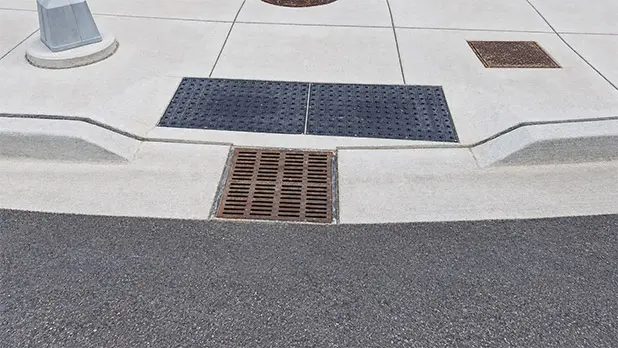
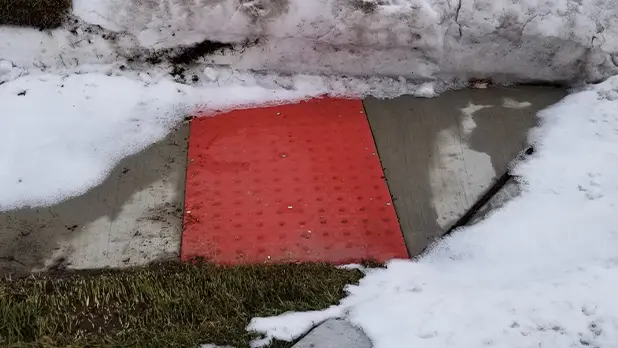
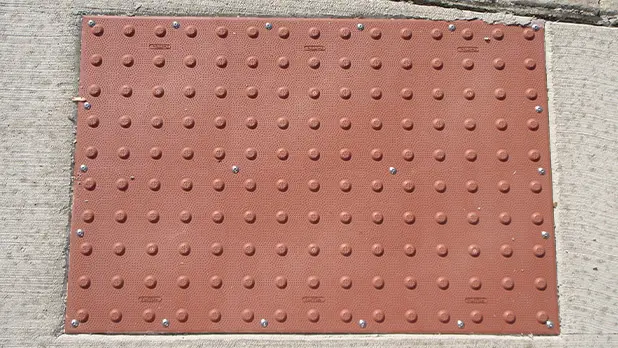
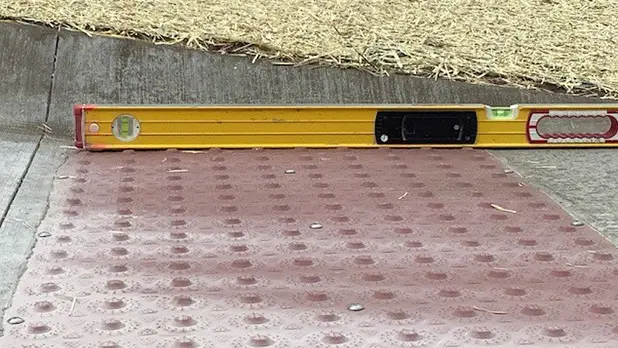
A transit platform places pedestrians immediately beside an operational rail or vehicle area, making the platform edge a particularly important location for a clear, consistent tactile warning.
Unlike some tactile wayfinding applications that rely on emerging guidance or agency practice, detectable warnings at transit platforms are addressed by established U.S. accessibility requirements in specified conditions. That makes careful coordination of pattern, coverage, contrast, material, and platform construction essential.
Why Platform Edges Receive Special Attention
Federal transportation accessibility requirements address detectable warning surfaces at specified boarding-platform edges where the hazardous edge is not protected by screens or guards, as well as certain vehicle-facing rail boarding and alighting areas.
The purpose of the truncated-dome surface is clear: it warns pedestrians that a hazardous rail or vehicle area lies immediately beyond the pedestrian space.
Project teams should identify the exact facility type and governing provisions before finalizing the detail, particularly where federal and transit-agency criteria overlap.
The Required Pattern Is Truncated Domes
Where a detectable warning is required, the appropriate tactile pattern is not arbitrary.
Section 705 of the ADA Standards defines detectable warnings using truncated domes and establishes technical criteria for dome geometry, spacing, and visual contrast.
Decorative textures, grooves, or directional bars should not be treated as substitutes for a required truncated-dome detectable warning surface.
Full-Length Coverage Matters
Platform warnings differ from the localized warning fields commonly associated with curb ramps.
For applicable rail-platform conditions, detectable warnings extend along the public-use boarding edge as required by the governing standard. That has practical implications for quantity takeoffs, joints, alignment, drainage, platform geometry, and coordination with edge construction.
U.S. practice also differs from some international systems that set warning surfaces back from the platform edge. Project teams should follow the specific U.S. and agency criteria governing the facility rather than adapting an unrelated tactile paving detail.
Visual Contrast Is Part of the Requirement
The warning surface needs to contrast visually with the adjacent walking surface using the applicable light-on-dark or dark-on-light relationship.
Platform finishes can include concrete, coatings, pavers, or other materials, so color selection should be coordinated with the surrounding surface early in design. Individual transit agencies may also establish more specific color requirements.
Coordinate the Complete Tactile System
A platform may contain more than one tactile cue.
Detectable Warning at the Edge
The DWS communicates the standardized hazard warning associated with the platform edge.
Directional or Boarding-Location Information
Some transit environments may also use TDIs to provide wayfinding or identify boarding-door locations. These raised-bar cues should remain distinguishable from the truncated-dome warning edge.
Research into transit-door TDIs found that they could be useful once encountered, while shorter treatments could be missed when pedestrians did not contact them while moving along the platform. That reinforces the need to design the overall tactile system around how pedestrians actually move through the station.
Material and Installation Considerations
Transit platforms can experience high pedestrian volumes, weather, deicing materials, cleaning, carts, and maintenance equipment.
TufTile offers detectable warning surfaces in galvanized steel, cast iron, and polymer, with wet-set and surface-applied options depending on material. The appropriate system should reflect the platform construction, exposure, maintenance program, project phasing, and agency requirements.
Existing stations may present very different installation constraints than new platforms. Material selection and installation method should therefore be evaluated together.
Agency Requirements Can Be More Specific
Transit authorities often maintain their own standard drawings, approved-product requirements, and construction criteria.
Those requirements may address color, width, placement, joints, fastening, or material in greater detail than a general federal summary. Current agency documents should be reviewed before the platform-edge system is specified or procured.
Treat the Warning Edge as Part of the Platform
The detectable warning surface should not be treated as a finish selected after the rest of the platform has been designed.
Slope, drainage, edge construction, circulation, lighting, barriers, platform-to-vehicle coordination, and other accessibility features all interact with the warning edge.
A well-coordinated platform detectable warning is recognizable, visually distinct, durable, and integrated with the complete station design from the beginning.