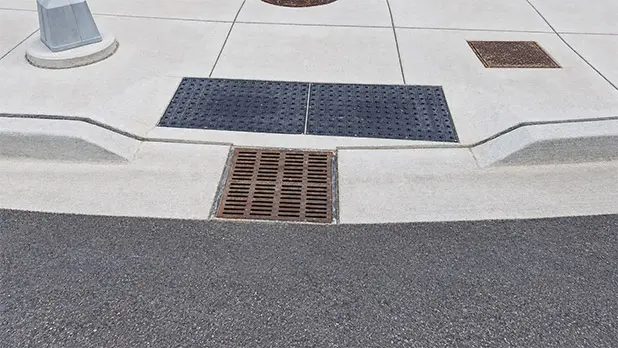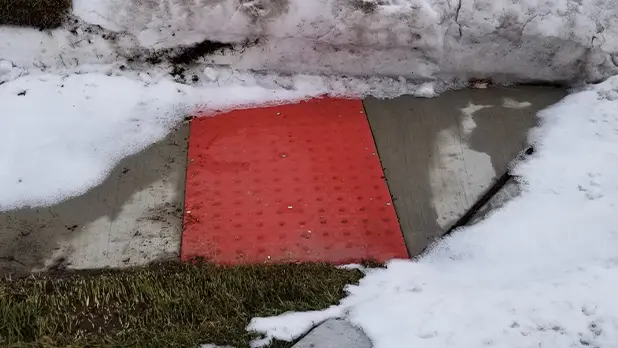
For properties in snowy climates, clearing pedestrian routes is an essential part of winter maintenance. But detectable warning surfaces introduce something that ordinary pavement doesn’t have: a field of raised tactile elements intentionally extending above the walking surface.
That difference matters when plows, shovels, brushes, blowers, and other snow-removal equipment move across them.
A detectable warning surface designed to withstand outdoor use can still be damaged by repeated equipment contact or an impact at the wrong angle. Winter maintenance plans should account for these surfaces before the first storm, not after a blade catches an edge or damages a row of truncated domes.
Why Snow Removal Is Different on a Tactile Surface
Most paved pedestrian surfaces are comparatively flat. Detectable Warning Surfaces (DWSs) are not.
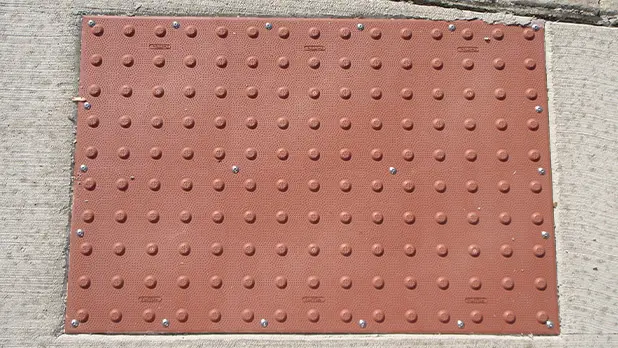
Their truncated domes create the standardized raised pattern pedestrians can recognize underfoot or with a long cane. That geometry is fundamental to the surface’s purpose, but it also changes how snow-removal equipment interacts with the pavement.
A plow blade traveling across ordinary concrete may pass over a relatively continuous plane. When it reaches a detectable warning surface, it encounters repeated raised elements along with joints, edges, fasteners, or other features associated with the installation.
The potential for contact depends on the equipment, its adjustment, direction of travel, pavement condition, installation, material, and maintenance practices.
Plow Blades Can Create Direct Impact
One of the clearest risks comes from a rigid blade contacting a raised feature or tile edge.
If a blade is set close to the pavement, an uneven surface, pavement transition, tile edge, or raised tactile element can become a point of impact. The force doesn’t necessarily remain confined to the spot where contact occurs—it can affect a dome, finish, fastener, tile edge, or other part of the installation.
Repeated passes can add another dimension. A location that receives frequent snow clearing throughout a long winter may experience many equipment interactions over a single season.
Direction of Travel Can Matter
How equipment approaches the detectable warning surface can influence the type of contact that occurs.
Crossing a securely installed tactile field isn’t the same as driving a blade directly into an exposed or vulnerable edge. Where site geometry allows, maintenance planning can consider the route equipment takes through curb ramps and other areas containing tactile surfaces.
This is especially worth thinking about at recurring trouble spots. If the same tile edge is damaged repeatedly, the maintenance route and equipment approach deserve review rather than treating each incident as an isolated product failure.
Not All Snow-Removal Equipment Interacts With DWTs the Same Way
“Snow removal” can describe very different operations.
A municipal plow clearing a roadway, a compact machine working on a sidewalk, a snowblower, a powered rotary brush, and a worker using a hand shovel apply different types and amounts of force to the surface.
Equipment selection often depends on the facility and snow conditions, so there isn’t one removal method that fits every detectable warning installation.
Mechanized Equipment
Plows and other powered equipment can clear large areas efficiently, but blade height, equipment weight, speed, operator technique, and the condition of the pavement can all influence how the equipment encounters a tactile surface. The objective around DWSs is to remove snow effectively without repeatedly striking or scraping raised components in a way that causes damage.
Manual Clearing
Hand tools can provide greater control in smaller areas such as individual curb ramps or building approaches. They aren’t risk-free, however. A shovel can still strike a dome or edge if it is driven forcefully across the surface.
The larger principle is the same regardless of equipment: recognize that the surface contains raised features and clear it accordingly.
Snow Coverage and Tactile Detectability Aren’t the Same Issue
It’s easy to assume that any amount of snow makes a detectable warning surface ineffective.
Available research suggests a more nuanced picture.
Research summarized in current U.S. tactile-wayfinding guidance found that DWS detectability did not necessarily diminish under a light layer of snow. Raised guidance strips presented a different challenge and were found difficult to follow when snow-covered.
That distinction matters because different tactile surfaces communicate information in different ways.
Detectable warnings use truncated domes to identify applicable hazards and transitions. Tactile Direction Indicators (TDIs) use raised bars for directional, location, or alignment information. Snow accumulation can interact differently with those patterns and the pedestrian tasks they support.
This doesn’t mean snow can simply be left on a DWS. Accessible pedestrian routes still need appropriate winter maintenance. It does mean that tactile systems should be considered individually rather than assuming every raised surface behaves identically under snow.
Darker Tile Colors Don’t Make Snow Disappear Faster
There’s another intuitive assumption worth addressing: a darker tactile surface should absorb more sunlight and melt snow more quickly.
Tactile-wayfinding research findings show that snow did not melt more readily on darker-colored tactile surfaces. So color shouldn’t be treated as a snow-management strategy.
Color selection has other important purposes, particularly providing appropriate visual contrast with the surrounding walking surface. Snow clearing still requires an actual maintenance plan regardless of whether the DWS is black, yellow, red, gray, or another color.
Material Selection Can Reflect the Expected Maintenance Environment
If frequent mechanical snow removal is part of normal site operations, that information can be useful before a detectable warning material is specified.
Research summarized in the tactile-wayfinding guide reports that cast iron and solid steel performed better in field testing where frequent snow removal was required.
That doesn’t establish metal as the required material for every snowy climate, nor does it mean a particular polymer product cannot be appropriate. Material performance is product- and application-specific.
It does reinforce a broader specification principle: Choose for the environment the product will actually experience.
A site with occasional hand clearing presents a different maintenance environment from a transit facility, municipal streetscape, or campus where powered equipment may cross tactile surfaces repeatedly throughout winter.
TufTile offers detectable warning products in galvanized steel, cast iron, and polymer, allowing project teams to compare materials alongside the maintenance practices expected at the site.
The Installation Method Matters, Too
Material isn’t the only part of the system that encounters snow-removal operations.
How the tile meets the surrounding pavement can influence what equipment encounters as it passes across the surface.
Surface-Applied Installations
Surface-applied detectable warning tiles are installed over existing concrete and mechanically secured according to the product’s installation requirements.
During winter inspections, attention can be given to perimeter edges, fasteners, sealant, and any indication that part of the tile is lifting or separating from the substrate.
An edge that has already become loose or damaged may be more vulnerable to further equipment contact.
Wet-Set Installations
Wet-set tiles are incorporated into fresh concrete, creating a different relationship between the tactile product and surrounding pavement.
Here, the condition of the concrete remains important. Cracking, settlement, spalling, or deterioration around the tile can change the transition that snow-removal equipment encounters.
In either system, a tile should be considered together with its edges, attachment or anchoring, and surrounding pavement rather than as an isolated component.
Curb Ramps Can Be Particularly Exposed
Curb ramps sit at an awkward intersection of pedestrian accessibility and winter operations.
They need to remain usable for pedestrians, but their location near the roadway can expose them to snow pushed from the street, sidewalk clearing, slush, and repeated maintenance activity from different directions.
Snow can also be deposited at the ramp after the sidewalk itself has already been cleared.
This makes coordination important. A sidewalk maintenance crew may clear one route while roadway plowing pushes additional snow back into the pedestrian area.
For owners and agencies responsible for both systems, curb ramps shouldn’t become an afterthought between roadway and sidewalk operations. The detectable warning surface and the accessible route around it need to remain part of the winter-maintenance plan.
Snow Storage Can Create Problems Even Without Equipment Contact
A plow doesn’t have to strike a detectable warning tile for snow operations to affect its usefulness.
Where cleared snow is deposited matters too.
Piling snow directly on a curb ramp or other tactile surface can obstruct the pedestrian route and cover the warning area. Repeated piles may also compact into dense snow or ice that becomes harder to remove later.
For sites where snow must be stored on limited available space, maintenance planning can identify locations that avoid:
- Detectable warning surfaces
- Curb ramps
- Pedestrian refuge areas
- Accessible entrances and routes
- Other tactile wayfinding features
Thinking about snow destination, not just snow removal, can prevent one maintenance operation from creating another accessibility problem.
Use Repeated Damage as Feedback
Winter maintenance records can reveal useful patterns.
If one curb ramp experiences damage year after year while neighboring installations do not, there may be more going on than normal seasonal wear.
Review the location:
- Is equipment approaching from the same direction each time?
- Is a tile edge unusually exposed?
- Has adjacent pavement settled?
- Is the equipment appropriate for the area?
- Is the blade being operated too close to the surface?
- Would a different maintenance route reduce direct impact?
A damaged DWS may need repair or replacement, but changing the practice that caused the damage can be equally important.
This turns inspection into feedback for the maintenance program rather than simply a record of what broke.
Winter Maintenance Starts With Coordination
The people selecting detectable warning products aren’t always the people who will maintain them.
An engineer may specify the system. A contractor installs it. Months or years later, a municipal public works crew, facility maintenance team, landscaping contractor, or snow-removal vendor may be responsible for clearing it.
Sharing information between those groups can help protect the installation.
For facilities with recurring winter conditions, maintenance planning can identify:
- Where tactile surfaces are located
- What types of tactile systems are present
- Which equipment will be used in those areas
- Where snow can be stored
- Who will inspect for damage
- How observed damage should be reported
Those are operational questions, not simply product questions—and answering them can help the installed system continue to function as intended.
Plan for Snow Before the Forecast Calls for It
Snow itself is only part of the winter challenge for detectable warning surfaces. How the snow is removed can matter just as much.
Raised tactile elements, tile edges, attachment points, and surrounding pavement all interact with the equipment used to keep pedestrian routes clear. Material and installation choices can account for those conditions, but good winter maintenance still depends on operators recognizing where tactile surfaces are located and treating them as intentional features of the walking surface.
For snow-prone sites, the best time to make that connection is before winter operations begin—not after the first damaged tile appears.