Adding a detectable warning surface to an existing sidewalk presents a different set of challenges than installing one as part of new concrete construction. The pavement is already in place, slopes and joints have been established, existing deterioration may need to be addressed, and the area may need to remain accessible throughout construction.
A successful detectable warning surface retrofit starts with the existing conditions. Before a product is selected, project teams need to determine what the location requires, whether the substrate can support the proposed system, and how the new warning surface will fit into the existing pedestrian environment.
Why Retrofit Projects Are Different
New construction gives designers and contractors more control over concrete placement, joints, elevation, and sequencing. Retrofit work requires the detectable warning system to respond to conditions that may have been built years earlier.
Those conditions can include cracks, spalling, uneven pavement, fixed expansion joints, drainage patterns, curb geometry, utility conflicts, or previous repairs. A retrofit should account for those realities rather than simply placing a tile over the available area.
Confirm Where a Detectable Warning Is Needed
Before selecting a tile, verify the governing requirements for the location.
Public-right-of-way curb ramps, transit facilities, private-site ramps, pedestrian islands, and rail crossings may be subject to different accessibility or agency criteria. Existing construction can make this particularly important because the condition being retrofitted may predate current requirements.
The project scope should clearly identify what is being corrected and which requirements govern the completed installation.
Evaluate the Existing Surface
A surface-applied detectable warning system depends on the substrate beneath it. A detectable warning tile should not be used to conceal concrete that first requires repair. Inspect existing concrete for:
- Cracking or spalling
- Scaling or deterioration
- Significant unevenness
- Contamination or existing coatings
- Drainage problems
- Unsuitable previous repairs
- Conflicts with joints or adjacent features
The surrounding pavement also influences how clearly a tactile surface can be detected. Research has shown that tactile warning surfaces can become harder to distinguish when adjacent pavement is unusually rough, cracked, heavily jointed, or similarly textured.
Surface-Applied Systems Can Reduce Demolition
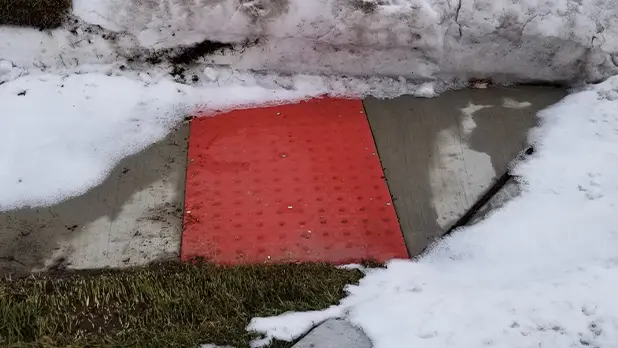
Where the existing substrate is suitable, surface-applied detectable warning tiles can provide a practical retrofit option without removing and repouring the entire ramp or sidewalk area.
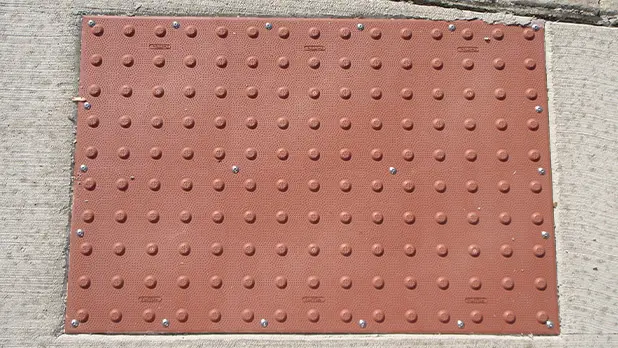
TufTile offers surface-applied systems in galvanized steel and polymer. These products are mechanically anchored and sealed according to the requirements of the selected system.
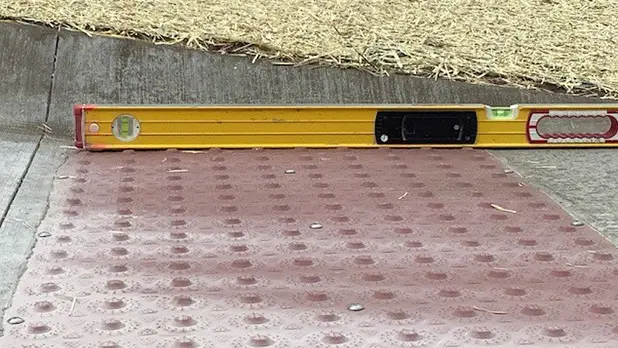
Reducing demolition can simplify the construction scope, but surface-applied installation still requires accurate layout, appropriate surface preparation, drilling, anchoring, and edge treatment. Retrofit should not be interpreted as shortcut installation.
Plan Around Joints, Curves, and Drainage
Existing sidewalks rarely provide a perfectly open rectangular field.
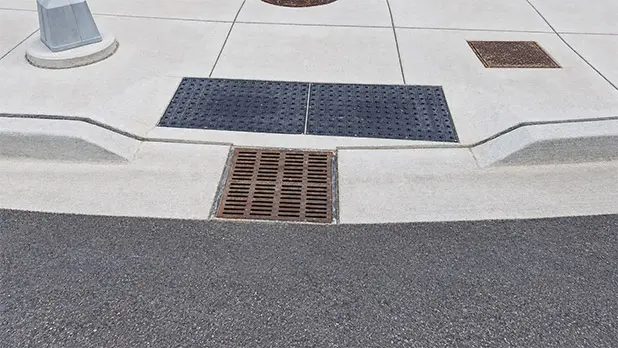
Expansion joints, saw cuts, curb radii, utility covers, poles, drainage paths, and pavement transitions can all affect the available warning-surface layout. Applicable placement criteria should be reviewed against the actual field conditions before tiles are ordered or cut.
Radius curb ramps require particular attention. Where the warning surface follows a curved curb, a radial dome arrangement may provide a more orderly solution than attempting to force straight-grid tiles around the curve.
Drainage also deserves review. The retrofit should not create new locations for standing water or interfere with existing drainage patterns.
Consider Pedestrian Access During Construction
Sidewalk retrofits often occur in active pedestrian environments, which means the construction plan needs to address more than the permanent installation.
Temporary pedestrian routing, barricades, drilling debris, equipment, sealant or curing times, and restoration all need to be coordinated so the work itself does not create unnecessary accessibility problems.
Surface-applied installation can avoid the full concrete curing period associated with replacement work, but the manufacturer’s instructions still determine when the completed system is ready for use.
Plan Ahead for the Next Repair
Many retrofit projects begin because an older detectable warning is missing, damaged, or no longer appropriate. That makes future maintenance especially relevant.
A replaceable system may allow a damaged component to be addressed later without reconstructing otherwise serviceable concrete. Keeping records of the product, size, color, installation system, and other details can make future maintenance considerably easier.
Owners should also inspect the completed retrofit over time for loose components, edge damage, debris, surrounding concrete deterioration, and changes that reduce visual contrast.
Treat the Retrofit as an Accessibility Project, Not a Patch
The goal of retrofitting a sidewalk with detectable warning tiles is not simply to cover an existing surface with truncated domes. The completed condition needs the appropriate warning location, geometry, visual contrast, substrate support, drainage, and installation quality for the project.
Surface-applied systems can make retrofit construction more efficient, but product selection should come after the accessibility requirements and existing field conditions have been understood.