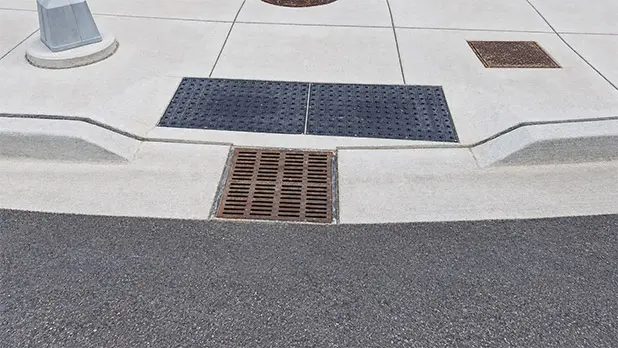
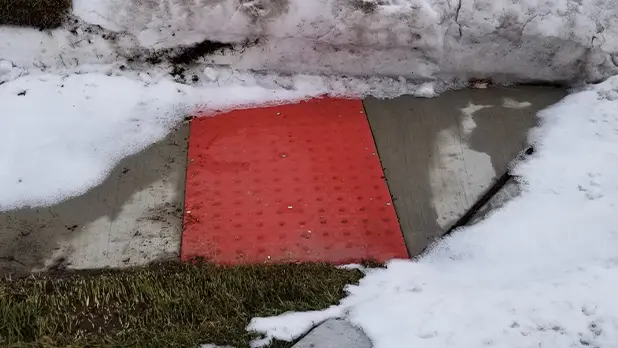
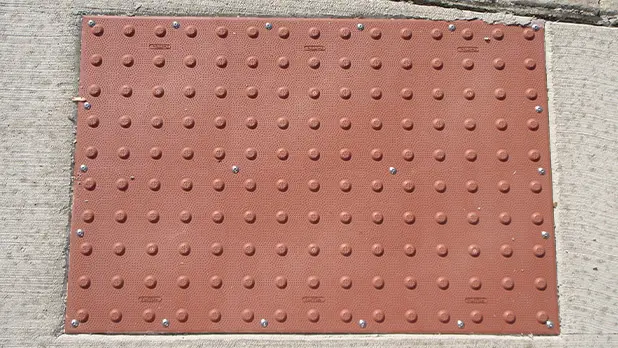
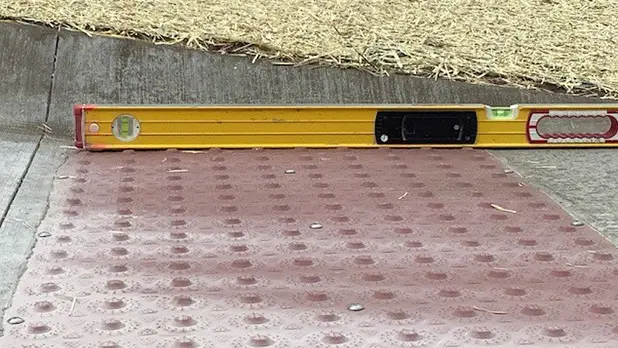
Tactile walking surface indicators should not be specified simply by choosing a product from a catalog and deciding where to place it. Different tactile patterns communicate different information, and the appropriate system depends on the pedestrian task, surrounding environment, applicable requirements, construction conditions, and long-term maintenance plan.
Before specifying tactile walking surface indicators (TWSIs), project teams can use a series of practical questions to move from the accessibility need to a buildable, maintainable system.
1. What Information Does the Pedestrian Need?
Start with function, not product.
Is the tactile surface intended to warn of a hazard, provide directional guidance or alignment, identify a location, or delineate a boundary?
DWSs, TDIs, and TWDs serve different purposes:
- DWS: standardized truncated-dome warning
- TDI: guidance, alignment, orientation, or location information
- TWD: same-grade boundary delineation where crossing is not intended
The built environment should also be evaluated before purpose-built guidance is added. Walls, building faces, landscaping edges, railings, and other detectable features may already provide useful non-visual information.
2. Which Standards and Agency Requirements Apply?
“ADA compliant” is not specific enough for a complete TWSI specification.
Identify the governing accessibility framework, jurisdiction, transportation agency, owner standards, and project specifications. Public-right-of-way work may involve PROWAG and state or municipal criteria, while transit facilities can involve ADA/DOT requirements and agency-specific standards.
This distinction becomes particularly important for TDIs and TWDs because there are currently no established national U.S. standards governing their dimensions and use comparable to those for DWSs.
3. What Tactile Pattern Is Needed?
Where multiple tactile patterns are used, establish the standardized warning locations first.
DWSs provide the recognized truncated-dome hazard warning. TWDs may then delineate same-grade boundaries where crossing is not intended, while TDIs can provide route, location, or alignment guidance.
For directional systems, drawings should clearly communicate orientation, beginnings and endings, turns, intersections, and transitions to other tactile surfaces. Where three or more TDI path segments intersect, research-based guidance supports a blank choice point rather than introducing truncated domes for a non-warning purpose.
4. What Material Fits the Environment?
Material selection should respond to how the site will actually operate. Consider the following aspects of your project and its location:
- Climate and weather exposure
- Pedestrian traffic
- Snow and ice operations
- Deicing materials
- Visual contrast
- Slip resistance
- Weight and handling
- Maintenance
- Appearance
- Replacement strategy
- Contractor familiarity
TufTile detectable warnings are available in galvanized steel, cast iron, and polymer. TDI and TWD products have their own material and configuration options.
The material should support the project environment without changing the intended tactile message.
5. Wet-Set or Surface-Applied?
Construction phase and substrate condition strongly influence installation method.
New concrete can create an opportunity for wet-set products. Existing cured surfaces may favor surface-applied systems when the substrate is suitable and demolition is undesirable.
Not every material is available both ways. TufTile cast iron, for example, is wet-set only, while its galvanized steel and polymer DWS lines provide both wet-set and surface-applied options.
6. How Will Radius and Special Conditions Be Handled?
Standard rectangular details do not solve every site condition.
Curved curb ramps, pedestrian islands, joints, shared-use paths, narrow guidance routes, and complex intersections may require specific layouts. Radius detectable warnings, for example, need to preserve the required truncated-dome geometry while following a curved curb.
TufTile’s EasyArc system is designed to help plan radius detectable-warning layouts using defined tile and wedge configurations.
7. What Does Long-Term Maintenance Look Like?
Think about how the system will be cleaned, inspected, repaired, and replaced before installation.
Ask how snow-removal equipment may interact with the surface, what finishes require, whether damaged components can be replaced, and how future maintenance teams will identify the installed product.
For tactile guidance systems, maintenance also needs to keep the route clear and preserve the continuity and meaning of the tactile cues.
8. Can the Specification Be Built as Drawn?
A technically sound concept still has to work in the field.
Reconcile product dimensions, curb geometry, joints, slopes, quantities, construction sequence, and actual available space before issuing the specification. Manufacturer submittals, engineering drawings, samples, and technical support can help identify conflicts before installation.
For larger wayfinding projects, input from orientation and mobility specialists can also help evaluate route logic, focus areas, decision points, and potential conflicts that may not be obvious from plan sheets alone.
A Better TWSI Specification Starts With Better Questions
A tactile system is most successful when every pattern has a defined job and every project decision supports that job.
Start with the pedestrian’s information need. Then identify the governing requirements, tactile pattern, material, installation method, geometry, and maintenance strategy.
That sequence produces a stronger specification than beginning with a particular tile and trying to make the project fit around it.